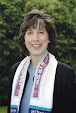
On Sunday, January 9, 2011, the Jewish world lost a most beautiful treasure:
Debbie Friedman, Jewish composer, singer, and teacher, died at the age of 59 from complications of pneumonia. On Friday, January 14th, at
Temple Israel we joined together for Shabbat in a tribute to Debbie Friedman through her music.
This is an excerpt from my remarks during the service:
Debbie Friedman’s first album, Sing Unto God, came out in 1972 when I was 4 years old, the same age my daughter is now. I probably did not have her album when I was 4, but within a year or two later, my Mom, Dad, sister, and I had gone on a family retreat with our synagogue to OSRUI in Oconomowoc, Wisconsin and discovered Debbie’s music. My friend across the street, Laura, and I spent hours listening to that album, dancing around her living room to the energetic and uplifting sounds of guitars, drums, and Debbie’s voice rising in prayer.
Over this past winter break I pulled out my old turntable from college and a box of albums in the basement to share some of the music from my youth with our kids. While I was dismayed to find out that I need a new turntable and, while I also do not have the Sing Unto God LP today (although Laura’s copy played just fine, we had made multiple trips to the record store to find the reason that our copy of the record skipped), I have all of her other early LPs, and most of her other recordings on cassette tapes and CDs.
Debbie’s music is, as many others have said, the soundtrack for the music of our lives. I learned Debbie’s music as I learned in religious school and Hebrew school what it is to be a Jew in contemporary America. Her prayer settings were what we sang and continue to sing in the youth choirs at Beth Emet synagogue where I grew up, in youth group, at camp, and in our congregations. My sister-in-law, who today is also a Reform rabbi, had the distinction of having a young Debbie Friedman perform at her bat mitzvah reception. I walked down the aisle at our wedding to her music, I have sung her music at the brit milah of each of our sons and the brit bat of our daughter, and her prayer settings accompanied the levayah of my father.
Over the years, at camp, at Women’s Rabbinic Network gatherings and in songleading classes at
Hava Nashira, I have been privileged to sit with Debbie and learn from her, and to hear her in concerts at the Jewish Folk festivals in Chicago, at many NFTY and URJ conventions. She and
Cantor Jeff Klepper have profoundly influenced my musical and spiritual development, and have been beacons in the world of Jewish songleading.
 |
| Debbie Friedman with Cantor Jeff Klepper, 2008 |
As Jerry Kaye, director of the
Olin-Sang-Ruby Union Institute (OSRUI) in Oconomowoc, Wisconsin, which was her second home, said: "For more than 40 years Debbie’s words and music were the voice, the expression of all we value and hold close to our hearts: love of Judaism; the power of our tradition in our lives to connect, inspire, heal and provide meaning, joy and sweetness.
Without doubt, Debbie was the inspiration for a new generation of worshippers…she made real the idea that art and religion are the only two human pursuits that bypass the intellect and speak directly to the soul. “
 |
| Hava Nashira Faculty 2010 |
Debbie Friedman started as a group song-leader at OSRUI in the early 1970s where she set Jewish liturgy to her own contemporary melodies. Her first album, “Sing Unto God”, was followed by 22 more. She is probably best known for her setting of “Mi Shebeirach”, the prayer for healing. Her gift to the world was her amazing ability to reach people and help them pray. She understood the power of prayer and felt her gift was to be a vessel for God’s power to convey this to others. By combining Hebrew texts with English in singable, folk-inspired melodies, she made the experience of prayer more accessible and taught us to pray with our voices in song. She was a pioneer in gender sensitive language, and helped transform the synagogue to make a place for the God of our mothers, and to make a place for those who were standing on the margins of the community, by honoring tradition but not fearing change. Most of all, Debbie taught that a prayer service, a song session, or a concert was not about the leader or performer, but about lifting the spirits of everyone in the room, inspiring everyone to sing and pray and connect to God.

Yet, despite the popularity of her music, Debbie Friedman struggled in the Jewish musical world for much of her career. In the 1970s and 80s the Jewish establishment and some cantors and rabbis dismissed her music as inappropriate in the synagogue. She never finished college, and she did not have cantorial training. She was not a classically trained musician. In fact, she could not even read music. When you would ask her, “What key is that in, or what guitar chords are you playing?”, she’d say, “ It’s this one, just put your fingers like this.” But as my mentor and teacher,
Cantor Jeff Klepper, who first met Debbie at
Kutz Camp in 1969, has written: “Musically she was untrained; her genius was intuitive and expressive. She could see the musical talent in others and knew how to bring it out. She understood prayer and was able to teach it in a way you could understand. Singing with her was exhilarating in ways that words cannot express.” Debbie Friedman was officially embraced by the Reform movement decades after her music had been informally welcomed and adopted in our camps and synagogue services. She was made an honorary member of the American Conference of Cantors and in 2007 was appointed to the faculty of our Reform seminary,
Hebrew Union College-Jewish Institute of Religion’s School of Sacred Music to teach music and prayer to our cantorial students.
Debbie Friedman’s life and work has profoundly changed modern Jewish worship. One of my fellow havanashirites shared that the highest level a song can reach is when it becomes so much a part of the canon that it is as if it was always there and nobody wrote it. This is what Debbie Friedman’s music and teaching has been to modern Jewish life, leaving behind a sacred teaching of which we cannot imagine a time when it wasn’t part of our spiritual lives.
We lost her during the week of Shabbat Shira, the Shabbat of Song, the Torah portion Beshalach, of the Song at the Sea. She was our Miriam, teaching us to pray with song. And it is also during this week, that the Haftarah is the story of Deborah the prophet. Arise, arise Devorah and sing your song–
Uri uri Dabri shir! Rest in peace, sweet singer in Israel.
Postscript to the sermon:
Debbie Friedman’s funeral was held in California on January 11th and over 7,000 people were able to watch the service via live internet streaming. Since then over 20,000 have viewed the archived service.
More information and tributes to Debbie Friedman, her life, and her music, including streaming video of other concerts in her memory are at the
URJ Debbie Friedman page,
Debbie Friedman's website and at the
"remembering debbie" page. Debbie's music is available on her website, at
URJ Books and Music, and on
itunes.


 Posts
Posts