As we move into the dark of December, illuminated by the Chanukah lights, many are busy with holiday plans, galas, and all the festivities that go along with them. We often worry this time of year about increasing waistlines, indigestion, and the diet and exercise program we will reluctantly start on January 1st. Yet, while so many are celebrating, while we enjoy the parties and the delicacies, the 2010 Hunger in America Study by Feeding America shows that the demand for food assistance by Hoosier families is increasing.
In a recent interview, Katy Bunder, the Executive Director of Food Finders, reported that: “The demand this past year has been nearly overwhelming. We hear more and more that people in our service area are suffering. Kids are going to bed hungry, families have no money for food after paying utilities and rent and seniors are having to choose to buy medication or to eat. We just believe there is more we can do.”
“Local statistics indicate that Food Finders serves an estimated 10,000 different clients per week in programs throughout the mid north Indiana service area. The survey samples also indicate that 33.9 % of all households seeking food assistance have at least one adult working. 27% of all adults had lost their jobs in the previous 11 months. Women comprise 64.3% of all clients at program sites and 43.1% of the households served have children younger than 18 years of age. In addition, results also show that 99% of clients have a place to prepare meals and more than half live in traditional households. 99% of clients at emergency food programs are US citizens and 73% of emergency food clients in Food Finders service areregistered voters. More than 50% of clients reported having very low food security which indicates one or more members either skip meals or experience increased hunger due to a lack of adequate resources for food.”
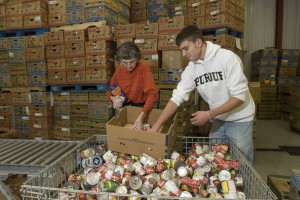
There are many organizations that help to fight hunger, and I encourage you to continue to support organizations that you have donated to in the past. Locally we have several food drives each year to support Food Finders. You can make donations of either foodstuffs or monetary donations: Food Finders Food Bank, Inc., 50 Olympia Ct., Lafayette, In 47909-5182 or donate online.
Nationally, MAZON: A Jewish Response to Hunger is a national nonprofit organization that allocates donations from the Jewish community to prevent and alleviate hunger among people of all faiths and backgrounds.
Each year, MAZON ( Hebrew for “sustenance”) grants over $4 million to more than 300 carefully screened hunger-relief agencies, including emergency food providers, food banks, multi-service organizations and advocacy groups that seek long-term solutions to the hunger problem. Many Jews now honor the Jewish tradition of not eating until you have provided for the poor by donating at least 3% of the cost of their life-cycle celebrations – weddings, bar mitzvahs, anniversaries, etc. Donate at: MAZON: A Jewish Response to Hunger, PO Box 894765 Los Angeles, CA 90189-4765 or online.
Our tradition teaches that we are to say a blessing (HaMotzi) before we eat a meal, and then to say a blessing (Birkat HaMazon) after we have eaten. Our sages asked, why is it necessary to recite a blessing after the meal when we have already thanked God for our food before the meal? We are taught that when we are hungry it is easy to be thankful for food. It is when we have been satisfied that is easy to take sustenance for granted and when we have finished eating that it is even more difficult to remember to be grateful. May we learn that sustenance is not something to be taken for granted, and may we help in being God’s partner by seeing to it that those in need know the feeling of a full stomach, rather than the pangs of hunger.
Friday, December 3, 2010
Friday, November 19, 2010
Giving Thanks - Hoda'ah
Baruch atah Adonai, ha-tov shimcha ul’cha na-eh l’hodot.
Blessed are you Eternal One, Your name is Goodness and You are worthy of thanksgiving.
These words form the chatimah, or seal, at the end of the Hoda’ah prayer, the second closing benediction of the Amidah (Modim Anachnu Lach). It is natural for us to go about our daily lives scarcely noticing the many blessings that we have each and every day. The words of the Hoda’ah remind us that we are surrounded by miracles and blessings – our lives, our health, our families and friends, our work in this world. The words of this prayer remind us to pause and notice them, to take a moment and lift our eyes up to see the beauty that is in this world, to feel the sun on our face, the wind in our hair, to see the beauty of autumn’s splendid palette of colors as the leaves float down to the ground.
When we pray and sing these words and give thanks for the miracles that we experience each and every day, we realize that we cannot take them for granted. Life is too precious, and these gifts are too important to notice them only when they are gone – when we have been sick, or have suffered pain and loss. Our daily recitation of the words of the Hoda’ah can lead us to a practice of being aware and appreciative of the miracles that surround us each day, and to also make it a practice of expressing our gratitude to God and to our loved ones.
At this season of thanksgiving, we are thankful for the daily miracles that surround us each day. As our awareness of them grows, may we be changed, lifted up, and transformed.
Blessed are you Eternal One, Your name is Goodness and You are worthy of thanksgiving.
These words form the chatimah, or seal, at the end of the Hoda’ah prayer, the second closing benediction of the Amidah (Modim Anachnu Lach). It is natural for us to go about our daily lives scarcely noticing the many blessings that we have each and every day. The words of the Hoda’ah remind us that we are surrounded by miracles and blessings – our lives, our health, our families and friends, our work in this world. The words of this prayer remind us to pause and notice them, to take a moment and lift our eyes up to see the beauty that is in this world, to feel the sun on our face, the wind in our hair, to see the beauty of autumn’s splendid palette of colors as the leaves float down to the ground.
When we pray and sing these words and give thanks for the miracles that we experience each and every day, we realize that we cannot take them for granted. Life is too precious, and these gifts are too important to notice them only when they are gone – when we have been sick, or have suffered pain and loss. Our daily recitation of the words of the Hoda’ah can lead us to a practice of being aware and appreciative of the miracles that surround us each day, and to also make it a practice of expressing our gratitude to God and to our loved ones.
At this season of thanksgiving, we are thankful for the daily miracles that surround us each day. As our awareness of them grows, may we be changed, lifted up, and transformed.
Friday, October 1, 2010
Engaging Israel
On Kol Nidre this year I spoke about the need to engage with Israel, to connect and be a part of our homeland:
Within all of the mixed up and challenging parts of Jewish life here in Israel, it is our place and if we do not stand up for pluralism and equal rights and claim Israel as ours too, we do so at our peril. Israel at 62 has its successes and its faults, its failures. On this holy day of Yom Kippur we recognize that we too have faults and failures, and that we too are still growing, striving, a work in progress. Today Israel needs our help to develop a new way of thinking based on Jewish values, taking the moral and ethical language of Judaism seriously in building this Jewish and democratic state. What Israel needs now is an ideology that addresses the state’s identity as a democratic society that is upheld by moral and ethical values of Judaism, that looks to our teachings to answer the dilemmas of power, sovereignty, social justice and human rights. Israel needs to be reminded of the idealism of the Zionist pioneers and that the ideals and dreams of the past can be developed into both new idealism and realism of the future.
How can we do this? Get beyond the headlines, go to Israel and touch your roots, walk in the footsteps of our history, see what our people has built.
I can’t tell you how many American liberal Jews I talk to who have been on many trips to Europe, and to Asia, but have not been to Israel. And, well, when I say that I’ve never really traveled Europe - I was in England once when I was in my late teens, but that I’ve been to Israel now 5 times, and hope to go many more times in the future, they look at me with confusion as to why I would go there more than once.
The Birthright trips have been a phenomenal success. Taglit Birthright Israel has in 10 years brought 250,000 young college-aged Jews to Israel. And of those quarter of a million kids who have experienced Israel on these trips, 17,000 of them now live in Israel (that’s 1 for every busload). If you are between 18 and 26, Sign up for a Kesher trip to Israel with Reform Judaism. Sign up now!
I would love to lead a group trip from on our congregation and if there are enough people interested, we can make that happen. Go on birthright, go to study, go on volunteers for Israel, go on a vacation. But don’t just go as a tourist.
As my colleague Rabbi Ed Feinstein says, “You can go to France or Italy or even Hawaii as a tourist. See the sites, enjoy the museums, eat in the cafes, shop in the markets. You'll have a wonderful time. But it's not yours. It's a lovely place to visit. But it doesn't belong to you. Israel is yours. The museums in Israel tell your story. The sites are filled with your memories. The cafes are filled with your people. Israel is yours. Go to Israel, and join the argument. Because the argument isn't just Israel's. The argument belongs to us as well.”
Learn more about Israel’s history. Too many American Jews do not know enough about the events leading up to the Jewish state or the history of present political and social conflicts in the Middle East. We are unaware of basic elements that are part of our history, and we are not aware of the amazing Jewish cultural and intellectual flourishing that is a result of the state of Israel’s founding. Read, discuss, debate. Read some more.
Support pluralism and diversity in Israel. In response to the recent arrest of Anat Hoffman for holding a Torah scroll, WOW has created a campaign to gather 10,000 photos of women holding Torah scrolls, which are being sent to leaders in Israel. Go through your photo albums from your bat mitzvah celebrations, and do the same. Come carry a Torah on Simchat Torah and upload your photo to the Women of the Wall weblink.
Send your monetary support to the Israel Religious Action Center, to Women of the Wall, to ARZA, to Reform congregations in Israel. Support The Israel Movement for Progressive Judaism, connect to liberal congregations in Israel through the World Union for Progressive Judaism and Kehillot B’Yachad. Subscribe to the Israel Religious Action Center, the Interreligious Coordinating Council of Israel and Women of the Wall newsletters.
Learn more about Israeli politics and Israeli culture. Read Haaretz and the Jerusalem Post online. Follow advocacy issues of religious freedom and equality in Israel through Hiddush. Rent an Israeli movie - most are subtitled. Read Israeli writers and novelists. Your Hebrew’s not so good? Don’t worry, many of them are translated into English. Listen to Israeli music and news on internet radio.
Find a way to connect to Israel, to engage with Israel this year. The words “klal Yisrael” are not just about the state of Israel but all Jews. We are all connected. We cannot ever forget that or let go of the challenge that Israel is a place for all Jews - it is ours to claim, and ours to dream. Im Tirtzu ayn zo agada - If you will it, it is no dream.
L’shalom,
Rabbi Audrey S. Pollack
Within all of the mixed up and challenging parts of Jewish life here in Israel, it is our place and if we do not stand up for pluralism and equal rights and claim Israel as ours too, we do so at our peril. Israel at 62 has its successes and its faults, its failures. On this holy day of Yom Kippur we recognize that we too have faults and failures, and that we too are still growing, striving, a work in progress. Today Israel needs our help to develop a new way of thinking based on Jewish values, taking the moral and ethical language of Judaism seriously in building this Jewish and democratic state. What Israel needs now is an ideology that addresses the state’s identity as a democratic society that is upheld by moral and ethical values of Judaism, that looks to our teachings to answer the dilemmas of power, sovereignty, social justice and human rights. Israel needs to be reminded of the idealism of the Zionist pioneers and that the ideals and dreams of the past can be developed into both new idealism and realism of the future.
How can we do this? Get beyond the headlines, go to Israel and touch your roots, walk in the footsteps of our history, see what our people has built.
I can’t tell you how many American liberal Jews I talk to who have been on many trips to Europe, and to Asia, but have not been to Israel. And, well, when I say that I’ve never really traveled Europe - I was in England once when I was in my late teens, but that I’ve been to Israel now 5 times, and hope to go many more times in the future, they look at me with confusion as to why I would go there more than once.
The Birthright trips have been a phenomenal success. Taglit Birthright Israel has in 10 years brought 250,000 young college-aged Jews to Israel. And of those quarter of a million kids who have experienced Israel on these trips, 17,000 of them now live in Israel (that’s 1 for every busload). If you are between 18 and 26, Sign up for a Kesher trip to Israel with Reform Judaism. Sign up now!
I would love to lead a group trip from on our congregation and if there are enough people interested, we can make that happen. Go on birthright, go to study, go on volunteers for Israel, go on a vacation. But don’t just go as a tourist.
As my colleague Rabbi Ed Feinstein says, “You can go to France or Italy or even Hawaii as a tourist. See the sites, enjoy the museums, eat in the cafes, shop in the markets. You'll have a wonderful time. But it's not yours. It's a lovely place to visit. But it doesn't belong to you. Israel is yours. The museums in Israel tell your story. The sites are filled with your memories. The cafes are filled with your people. Israel is yours. Go to Israel, and join the argument. Because the argument isn't just Israel's. The argument belongs to us as well.”
Learn more about Israel’s history. Too many American Jews do not know enough about the events leading up to the Jewish state or the history of present political and social conflicts in the Middle East. We are unaware of basic elements that are part of our history, and we are not aware of the amazing Jewish cultural and intellectual flourishing that is a result of the state of Israel’s founding. Read, discuss, debate. Read some more.
Support pluralism and diversity in Israel. In response to the recent arrest of Anat Hoffman for holding a Torah scroll, WOW has created a campaign to gather 10,000 photos of women holding Torah scrolls, which are being sent to leaders in Israel. Go through your photo albums from your bat mitzvah celebrations, and do the same. Come carry a Torah on Simchat Torah and upload your photo to the Women of the Wall weblink.
Send your monetary support to the Israel Religious Action Center, to Women of the Wall, to ARZA, to Reform congregations in Israel. Support The Israel Movement for Progressive Judaism, connect to liberal congregations in Israel through the World Union for Progressive Judaism and Kehillot B’Yachad. Subscribe to the Israel Religious Action Center, the Interreligious Coordinating Council of Israel and Women of the Wall newsletters.
Learn more about Israeli politics and Israeli culture. Read Haaretz and the Jerusalem Post online. Follow advocacy issues of religious freedom and equality in Israel through Hiddush. Rent an Israeli movie - most are subtitled. Read Israeli writers and novelists. Your Hebrew’s not so good? Don’t worry, many of them are translated into English. Listen to Israeli music and news on internet radio.
Find a way to connect to Israel, to engage with Israel this year. The words “klal Yisrael” are not just about the state of Israel but all Jews. We are all connected. We cannot ever forget that or let go of the challenge that Israel is a place for all Jews - it is ours to claim, and ours to dream. Im Tirtzu ayn zo agada - If you will it, it is no dream.
L’shalom,
Rabbi Audrey S. Pollack
Monday, August 30, 2010
September 2010 bulletin article
On the morning that the month of Elul began this year, I stood at the Kotel, the Western Wall in Jerusalem to welcome the new month with the sound of the shofar. I stood with a large group of women, gathered to pray and give thanks to God, and to reflect on the month that was beginning, as we began to prepare for the journey to the new year about to begin in just four short weeks.
That same afternoon, I returned to the Kotel, and witnessed the swearing in ceremonies for new IDF soldiers. Friends and families gathered at the Kotel plaza, watching with a mix of pride and anxiety, knowing full well the dangers that might lie ahead for these young men and women, who must serve in order to protect and defend our Jewish homeland.
And later, I went into the tunnels that have been excavated underneath the Kotel, and pressed my hand onto the stones closest to the Holy of Holies, the same stones that have witnessed history for thousands of years.
In the Yiddish play The Dybbuk, the author Shalom Ansky, conveys a sense of what it must have been like to be among those at the Temple in ancient times:
“God's world is great and holy. The holiest land in the world is the land of Israel. In the land of Israel the holiest city is Jerusalem. In Jerusalem the holiest place was the Temple, and in the Temple the holiest spot was the Holy of Holies.... There are seventy peoples in the world. The holiest among these is the people of Israel. The holiest of the people of Israel is the tribe of Levi. In the tribe of Levi the holiest are the priests. Among the priests, the holiest was the High Priest.... There are 354 days in the [lunar] year. Among these, the holidays are holy. Higher than these is the holiness of the Sabbath. Among Sabbaths, the holiest is the Day of Atonement, the Sabbath of Sabbaths.... There are seventy languages in the world. The holiest is Hebrew. Holier than all else in this language is the holy Torah, and in the Torah the holiest part is the Ten Commandments. In the Ten Commandments the holiest of all words is the name of God.... And once during the year, at a certain hour, these four supreme sanctities of the world were joined with one another. That was on the Day of Atonement, when the High Priest would enter the Holy of Holies and there utter the name of God. And because this hour was beyond measure holy and awesome, it was the time of utmost peril not only for the High Priest but for the whole of Israel. For if in this hour there had, God forbid, entered the mind of the High Priest a false or sinful thought, the entire world would have been destroyed. Every spot where a man raises his eyes to heaven is a holy of holies. Every man, having been created by God in His own image and likeness, is a high priest. Every day of a man's life is a Day of Atonement, and every word that a man speaks with sincerity is the Name of the Lord. Therefore it is that every sin and every wrong that a man commits brings the destruction of the world.”
As we move through the month of Elul and prepare for the Yamim Noraim, we each prepare to enter into our own holy of holies. We consider all that has happened in the past year and all that we hope and pray for in the year to come. With prayer and song and reflection we enter into a sacred and holy space, a place which transcends time and space and sets us back on the path of remembering, where we have been, who we are, who we are meant to be. On the High Holidays we leave behind our ordinary lives and enter into the holy of holies, and hear again the ancient call of the shofar, summoning us to return - to God, to our true selves, to the path of teshuvah and tikkun olam.
May this year 5771 be for all of us a year of blessing, health, joy, and return,
Rabbi Audrey S. Pollack
Friday, August 20, 2010
Returning Home
I was very sad (we all were) to leave Israel, knowing that our time here has come to an end. It has been a wonderful, enriching, challenging, and growing journey. My Hebrew has improved, so have my text skills, I am learning slowly, to play a new instrument, and I have relished the time with my family to play with them and see them grow and see Israel through their eyes. I’ve been able to slow down, to walk more, to take time for myself to do what makes my heart sing. But duty calls, and the school year is now upon us.
I’m making an ongoing commitment to myself to make time for my own study and growth, to set aside time each week to continue to cultivate what I have been learning, Torah lishma, for its own sake, not just to prepare to teach another class.
We arrived home very late at night, jet lagged, after a somewhat challenging journey, to find that someone had tp’ed our house in a serious way. We think it was a case of mistaken address, but it does seem strange that it was the night we came home. We are not enjoying the clean up.
In the aftermath of the summer storms here (we received pictures over email), the house looks fine, the goldfish are still alive! and the kids are starting back to school (so what’s a little jet lag the first week).
And we went out into the yard to see our apples, growing, red and round and delicious from the summer sun and rain.
Thursday, August 12, 2010
End of Pardes
It’s the end of my study time here in Yerushalayim. For the end of our study session, we had a siyyum lunch, and people shared their thoughts on the summer in the form of words, poems, and songs. I didn’t get up and give a speech, but here’s what I would have said: I will miss getting up every day and walking to the bus, riding the bus and listening to the radio or to the conversations in Hebrew, seeing people reading Hebrew newspapers, or studying gemara, or praying tehillim on the way to work and school. I will miss the slowed down rhythm and the peace of Shabbat where you can walk and walk and not hear any sound except those of your own footsteps and a very occasional car on your way to shul. I will miss the possibility of being able to attend more than a dozen, perhaps two dozen synagogues in less than a 20 minute walk from where I live. I will miss wishing the guy in the corner makolet or the clerk at SuperSol “Shabbat Shalom” and have them answer “Shabbat Shalom” in return as if it was the most natural thing in the world, because here in Yerushalayim, it is. I will miss the quiet of knowing that right now all that I have to attend to is this piece of gemara in front of me, even if I am seriously questioning the meaning of the Aramaic and wondering where all of the things that I used to know went out of my head - was it the 16 years of rabbinic work, or lack of sleep from the kids, or does the hard drive just have too much information being stored there. It’s the end of Pardes (yes the English word paradise is related, probably they are originally from the Persian). In Hebrew and in Jewish text, the word Pardes is an acronym for ways of understanding text: P’shat (simple or plain meaning); Remez (hint or allegorical meaning); D’rash (the midrashic or interpretive sense); and Sod (the secret or mystical meaning). Yerushalayim is a place of Pardes. It’s a place that has many planes of existence.
Rosh Chodesh Elul

This Wednesday morning, I again woke early to join Women of the Wall for Rosh Chodesh Elul at the Kotel. Again a large group of more than 100 women gathered on the women’s side of the mehitza, and male supporters joined in solidarity opposite us on the other side. Elul marks the beginning of the daily sounding of the shofar and the chanting of penetential prayers as we move towards the High Holidays, and you can feel changes in the air as the days begin to shorten, and the summer begins to move closer to its end and the new year approaches. This month Anat Hoffman, the leader of Women of the Wall, could not join us, as she is still banned from the Kotel, so she waits for us at the entrance to the Southern wall with the Torah.
In the bright sunlight that began to move across the Kotel plaza, we chanted the morning prayers, and listened to the sounds of men praying on the other side of the mechitza, the divider; and listened to the sounds of both men and women screaming and cursing at us for daring to pray in a group and allow the sounds of our voices singing to be heard. We chanted Hallel, loudly, amid admonitions to “shush” and “lower your voices”, praising God for the new month that had arrived. We listened to the sounds of several shofarot being blown across the divider, in the men’s section, and then recited the blessing to hear the sound of our shofar, as it been sounded at the Kotel by Anat Hoffman, for these past 21 years. We said the blessing, and then as we listened, instead we did not hear it, because the shofar was snatched out of the hands of the baalat tekiah (shofar blower) by the chief of police.
We were then able this month to move calmly to the Robinson’s Arch at the Sourthern wall where Anat met us with the Torah. While several women donned tefillin, as is their daily custom, the Torah was prepared for reading. I was delighted to recognize several friends in the crowd, including Rabbi Jackie Koch Ellenson, director of the Women’s Rabbinic Network, and Cantor Rikki Lippitz, who lives in New York but is from my home congregation (where I grew up). Here we heard several shofarot blown, as well as beautiful Torah readings.
Opponents of the group question why Women of the Wall doesn’t just settle for holding all of their davening here at the Southern Wall. The answer is simple - the wall belongs to the entire Jewish people. It is not an orthodox synagogue. It is a symbol for all Jews. That is why the MK Nitzan Horowitz, leader of the Knesset’s lobby for civil equality and pluralism plans to introduce a bill that proposes the Kotel be divided into three sections, including a space which is non-segregated and inclusive. Stay tuned.
For more:
Jerusalem Post: Women of the Wall to Hold Kotel Services
Rosh Chodesh Elul and Women of the Wall
Time Magazine: In Israel, A Fight to Make the Wall More Inclusive
The Forward: For the First Time Since Leaders Arrest, Women of the Wall Gather Amid Angry Protest
Perfect Harmony
Subscribe to:
Posts (Atom)