We learn in the Mishnah Pirke Avot (2:15–16) the words of Rabbi Tarfon, who lived in the 2nd century CE: Lo alecha hamlacha ligmor, v’lo atah ben chorin l’hibateil mimena. “You are not required to finish the work, yet you are not free to avoid it.”
This is true of the work we do here at Temple Israel. Although running our synagogue is demanding and at times may seem overwhelming, we must never be discouraged. To all of the members of our Temple Israel family who take this advice to heart, please know that your work is vital and important and worthwhile. You are the caretakers of our Jewish community.
We are now, this week, beginning the book of BeMidbar, known in English as the book of Numbers. The Hebrew is best translated as, “in the wilderness.” For the last 32 days, we have been counting the Omer. Every day, on our 49-day journey from Pesach to Shavuot, from Egypt to Sinai, brings us closer to receiving and understanding Torah. Being BeMidbar, “in the wilderness,” teaches us that the journey is a series of small but deliberate steps, always moving forward, always on the journey—together.
BeMidbar opens with a census, counting all the men of b’nei Yisrael over the age of 20—that is, all of the men who would be eligible to serve as part of an army—from all the tribes, except Levi. The number adds up to 603,550. Here at Temple Israel, in 2014, we count women and children too. But either way, the counting serves to remind the b’nei Yisrael, and us as b’nei Yisrael of Temple Israel, that every one of us counts and is needed for our Jewish community to thrive on this journey that we are on together.
Each person and family who have hosted oneg Shabbats, baked or cooked and decorated for holidays and life cycle events, worked in the cemetery, cleaned up, played a musical instrument, donated your time, donated money, and contributed in countless ways to the life of our synagogue, including those of you who have participated in multiple committee meetings that sometimes go until late in the evening, you already know this: sometimes we have to work late into the night, but it’s not without its rewards. Some great ideas have come out of those late-night meetings.
We are a small community, but there are many ways we can grow. There are always limiting factors, like money and volunteer hours. And we know that progress doesn’t always come so easily. Keeping a congregation going is always a challenging task. We may simultaneously feel inspired and tested, and we know that success doesn’t happen overnight. Sometimes, we have to come back and try again and again.
But know that what makes this community and this place sacred is our connection to each other, our coming together to sanctify our lives and to offer praise and thanks together, our accompanying each other on the journeys of brit and baby naming, b’nei mitzvah, confirmation—-chuppah and parenthood—grief and mourning, learning and prayer, and relationships.
Do you remember Rabbi Tarfon, whom we started with? He also teaches in that same Mishnah: Hayom Katzar v’hamlachah m’rubah,
v’hapoalim atzelim v’hasachar harbeh u’vaal habayit dochek. “The day is short, the work is great, the workers are lazy, but the reward is great, and the master of the house is knocking [at your door].”
The truth about being part of a kehillah kedoshah, a holy community, is that the work is long and the expressions of gratitude often are not. What keeps us doing this then, year after year? Because you believe your work is worthwhile. You don’t do it for the recognition. You do it, because you care. At the end of the day, at the end of the year, we have successes, sometimes we have mistakes, but what truly matters, what makes us a holy community in the service of God is that we are here to support each other in times of celebration and in times of sadness; that our children learn and feel a sense of accomplishment, and that the members of our Temple family know they matter and have an important place in our community.
Showing posts with label mitzvah. Show all posts
Showing posts with label mitzvah. Show all posts
Monday, May 19, 2014

Sunday, March 10, 2013
Bar Mitzvah on the Brain
Less positive were some of the more controversial pieces that have appeared within the last few weeks, such as this save-the-date video. As a rabbi and a mom, I have followed the discussions and news features on this one with interest, but in the end, I hope that for this young man, he will be able to remember his bar mitzvah not for all of the notoriety or controversy that has accompanied his save-the-date video, but for the meaningful ritual of welcome into adult Jewish life that the ceremony is meant to be.

I can’t stand the idea that the message for young adults today, and for their family members and guests is only about the party, such as in this montage of photographs from bar and bat mitzvah parties. And I find it scary that there is a market out there for bar and bat mitzvah simcha speeches in which you can hire a rabbi to ghost-write the speech for the parents or even the bar mitzvah boy or bat mitzvah girl’s d‘var torah.
I want my son and the bar and bat mitzvah students in our small congregation to know that bar and bat mitzvah is about preparation for a lifetime as a Jewish adult, that it’s not just an “event” that is all over by the next morning. I want my son to be part of building a Jewish community that is a place where most of these b’nei mitzvah will regularly lead worship, read Torah, and wear their tallitot after the big day is over. Not that this is all there is to becoming a Jewish adult, but these certainly are the responsibilities that a young man or woman is being prepared for. I hope that I am able to teach them that becoming a bar or bat mitzvah is about attaining a certain level of Jewish literacy, and spiritual development, and that this is an ongoing process of Jewish adulthood. I want them to learn and grow and question and look at the bigger picture of what they will be able to do within the context of their Jewish lives and our community. That is what it means to become a bar and bat mitzvah, and take the next step on your Jewish journey. And that is why as a rabbi and a mom, I continue to do the important work of helping young people and their families connect to bar and bat mitzvah as a time for learning, practice and celebration, within the context of a meaningful, relevant Jewish life.
(cross posted at Kol Isha, the blog of the Women's Rabbinic Network)
Friday, March 1, 2013
The Pesach Project - Passover in the FSU
40 years ago, in 1974, 26 year old Soviet Jewish dissident Natan Sharansky attended his first seder. For Sharansky, it was not difficult to identify with the Pesach story of freedom told in the Haggadah. As a dissident, his life was made difficult and KGB agents waited around every corner. Some years later Sharansky led his own seder for the first time, but without the benefit of a Haggadah to read, or any of the elements of the seder to enjoy – no karpas, no matzah, no maror. Sharansky was alone in his prison cell but he did recount the story of Pesach to the prisoners next door through the small window of his cell.
For the community of dissidents in the Soviet Union of the 1970s no symbols were needed to remind them of the power that freedom has to transform society. The compelling story of the Exodus from Egypt, a nation of slaves rising up to defeat the most powerful Pharoah and his army, and lead the people forward to be a free people in their own nation was not ancient history, it was a symbol of of their cause. They understood the bitter tears of slavery that the Jewish people shed while in Egypt. For Sharansky and his fellow prisoners, their lives were a prayer and hope that the yoke of oppression would soon be broken and they would be able to sit reclining at the seder table and taste the flavor of freedom in years to come. In 1986 Sharansky was finally released from Soviet imprisonment and he made aliyah to Israel. He is now the chairman of the Jewish Agency for Israel, the organization in charge of immigration and absorption of Jews from the diaspora into Israel.
As we sit at our seder tables this year, it may seem that 40 years is a short time, a blip in history. Yet our people wandered forty years in the desert on the way to the Promised Land. And our work is not yet done.
Today in the former Soviet Union it is now possible to both learn about and practice Judaism: The Reform movement (known as the World Union for Progressive Judaism -WUPJ) in the FSU has an active and vital presence: “After over 70 years of Communism, religious oppression and persecution, Jewish communities in the FSU have once again become vibrant with the World Union's assistance."
The first congregation to officially join the Reform movement was Hineini in Moscow in 1990. Today, over 60 congregations in Russia, Ukraine, Belarus and the Baltic states, spanning 11 time zones from the Polish border to the Pacific Ocean, have officially become part of the World Union family, which now has offices in Moscow, St. Petersburg, Kiev and Minsk. There are currently six native-born rabbis and a full-time academic program, Machon, (the Institute for Modern Jewish Studies), to locate and train local paraprofessional community workers.
The Progressive movement operates nursery schools and Sunday schools all over the FSU under the leadership of a team of full-time education directors. Netzer Olami, the international Zionist youth movement of the World Union for Progressive Judaism, has become the largest Jewish youth movement in the FSU, operating summer and winter camps for some 1,000 participants, as well as youth clubs and counselor training programs.
This Pesach, our former WELFTY advisor, Chase Foster, now a 1st year rabbinic student at Hebrew Union College (HUC) in Jerusalem will be participating this year in the Pesach Project, an annual program through HUC and the World Union for Progressive Judaism. He will be traveling along with 20 classmates to Berlin and then to various cities in the FSU - Gomel, Minsk and Lida, Belarus to assist small Jewish communities that do not have the resources to provide for Jewish professionals. Last year’s FSU trip allowed approximately 5,500 people to join around the seder table with community for Passover. Chase has committed to fundraising $2500 for the Pesach project to help Jews in the FSU celebrate Pesach.
At this season of freedom, may our love for the Jewish people and our support for outreach and education make this Passover a time of re-commitment to our people and our faith.
For the community of dissidents in the Soviet Union of the 1970s no symbols were needed to remind them of the power that freedom has to transform society. The compelling story of the Exodus from Egypt, a nation of slaves rising up to defeat the most powerful Pharoah and his army, and lead the people forward to be a free people in their own nation was not ancient history, it was a symbol of of their cause. They understood the bitter tears of slavery that the Jewish people shed while in Egypt. For Sharansky and his fellow prisoners, their lives were a prayer and hope that the yoke of oppression would soon be broken and they would be able to sit reclining at the seder table and taste the flavor of freedom in years to come. In 1986 Sharansky was finally released from Soviet imprisonment and he made aliyah to Israel. He is now the chairman of the Jewish Agency for Israel, the organization in charge of immigration and absorption of Jews from the diaspora into Israel.
As we sit at our seder tables this year, it may seem that 40 years is a short time, a blip in history. Yet our people wandered forty years in the desert on the way to the Promised Land. And our work is not yet done.
Today in the former Soviet Union it is now possible to both learn about and practice Judaism: The Reform movement (known as the World Union for Progressive Judaism -WUPJ) in the FSU has an active and vital presence: “After over 70 years of Communism, religious oppression and persecution, Jewish communities in the FSU have once again become vibrant with the World Union's assistance."
The Progressive movement operates nursery schools and Sunday schools all over the FSU under the leadership of a team of full-time education directors. Netzer Olami, the international Zionist youth movement of the World Union for Progressive Judaism, has become the largest Jewish youth movement in the FSU, operating summer and winter camps for some 1,000 participants, as well as youth clubs and counselor training programs.
This Pesach, our former WELFTY advisor, Chase Foster, now a 1st year rabbinic student at Hebrew Union College (HUC) in Jerusalem will be participating this year in the Pesach Project, an annual program through HUC and the World Union for Progressive Judaism. He will be traveling along with 20 classmates to Berlin and then to various cities in the FSU - Gomel, Minsk and Lida, Belarus to assist small Jewish communities that do not have the resources to provide for Jewish professionals. Last year’s FSU trip allowed approximately 5,500 people to join around the seder table with community for Passover. Chase has committed to fundraising $2500 for the Pesach project to help Jews in the FSU celebrate Pesach.
At this season of freedom, may our love for the Jewish people and our support for outreach and education make this Passover a time of re-commitment to our people and our faith.
Friday, January 18, 2013
Remembering Dr. Martin Luther King Jr.
This week I had the privilege of participating in the Women’s Rabbinic Network convention in Memphis TN. Our bi-annual convention of Reform women rabbis from across North America (and one colleague from the former Soviet Union who now lives in Israel), gathered for 4 days of rich learning, beautiful praying and singing, and sisterhood and support. I was privileged to work on planning and leading the opening and closing ritual moments and part of our tefillot (worship) together.
As part of our gathering in Memphis, we went to the Lorraine Hotel where Rev. Dr. Martin Luther King Jr. was assassinated on the evening of April 4, 1968 and the Civil Rights museum. It was very moving to be in Memphis during the week of Dr. King’s birthday. Had he lived, he would have been 84 years old. As we stood together in Memphis at that place where we all lost so much, we reflected on his life and legacy, on what a rare gift he gave to the world with his courage and his passion.
On Tuesday, Dr. King’s birthday, there was an ice storm in Memphis. Many of the downtown area shops and businesses closed, sending their workers home early. At dinner we rose and gave a standing ovation to the hotel wait staff, who had not gone home early, and were there serving our meal, and tending to the needs of hotel guests. (full disclosure, we do this at every one of our WRN conventions, because just as we thank God for food in the Motzi and Birkat hamazon, we are mindful that it is through many hands that food comes to our table each and every day.) As we stood, I was reminded of why Dr. King had gone to Memphis in April of 1968 - sanitation workers in Memphis had staged a walkout to protest unequal wages and working conditions. Black workers were paid significantly less than whites and received no pay if they stayed home in and weather, while their white counterparts were paid. So many of them were compelled to work in rain and snow storms. King had come to Memphis to prepare for a March the following Monday in support of these striking workers.
Our parashah this week is parashat Bo – “Bo el Paroah”, begins the text, as God says to Moses, “Go to Pharoah”, for I have hardened his heart. God tells Moses to go to Pharoah, his heart hardened, and ask Pharoah to let God’s people go forth from slavery to freedom. It is the message of God to Moses and the teaching of God in Exodus that led Dr. King to have the faith to dream of the end of racial segregation and racial discrimination and achieve equality through the civil rights movement.
Moses does as God tells him and goes to Pharoah demanding that Phaorah let the Jewish people go. But Pharaoh, his heart hardened, responds to Moses’ requests by rebuking him and increasing their workload, making life harder for the Jewish slaves. When the civil rights movement began to gain support, southern whites responded by making the lives of black Americans more difficult, threatening and assaulting civil rights leaders with violence, ultimately taking Dr. King’s life.
Many Jews felt compelled to respond to the fight against racial segregation and discrimination in America. We remembered the teachings of Torah and the call of the rabbis – “you shall not stand by while your neighbor bleeds”, “remember the poor and the stranger, for you were strangers in the land of Egypt”. We knew what it was like to experience discrimination and hatred. So many Jews felt called by faith and familiarity to serve in the cause of racial justice and equality.

On the march from Selma to Montgomery in March 1965, Rabbi Abraham Joshua Heschel walked in the front row with King, a spiritual partner in the struggle against racism. On a conference table in the Union for Reform Judaism’s Religious action Center building, black and Jewish lawyers drafted the Civil Rights Act of 1964 and the Voting Rights Act of 1965. The president of the NAACP at the time was Kivie Kaplan, a prominent member of the Reform movement’s social action commission. Today, Rabbi David Saperstein, the head of the URJ’s Religious Action Center in Washington, is the only non-African American on the board of the NAACP.
This coming August marks 50 years since Rev. King’s galvanizing, inspirational speech delivered on the steps of the Lincoln Memorial in Washington DC and 150 years since President Lincoln signed into law the Emancipation Proclamation.
50 years after Dr. King spoke of the dream that he had for this great country, civil rights and the fight for equality remain an important issue. Dr. King’s dream has not yet been achieved when we continue to see efforts to disenfranchise voters. Dr. King’s dream has not yet been achieved when there is still discrimination in this country towards people of different colors, religions, or ethnic origins. Dr. King’s dream has not yet been achieved when there is discrimination against people because of their sexual orientation. But he had the courage and the faith and the conviction to go forward, and his legacy still burns clearly today as we celebrate his birthday this weekend. He had the courage and faith that Moses had to “Bo El Paroah”, to go to Phaorah and say “let me people go.” His work in the world is now ours to do. As our rabbis teach in Mishna Pirke Avot 2:20-21 “Lo alecha hamlacha ligmor, vlo atah ben chorin lhibateil mimena. “It is not your duty to complete the work, but neither are you free to desist from it. As we honor Dr. King this weekend, let us remember that it is our responsibility to carry on his legacy.
As part of our gathering in Memphis, we went to the Lorraine Hotel where Rev. Dr. Martin Luther King Jr. was assassinated on the evening of April 4, 1968 and the Civil Rights museum. It was very moving to be in Memphis during the week of Dr. King’s birthday. Had he lived, he would have been 84 years old. As we stood together in Memphis at that place where we all lost so much, we reflected on his life and legacy, on what a rare gift he gave to the world with his courage and his passion.
On Tuesday, Dr. King’s birthday, there was an ice storm in Memphis. Many of the downtown area shops and businesses closed, sending their workers home early. At dinner we rose and gave a standing ovation to the hotel wait staff, who had not gone home early, and were there serving our meal, and tending to the needs of hotel guests. (full disclosure, we do this at every one of our WRN conventions, because just as we thank God for food in the Motzi and Birkat hamazon, we are mindful that it is through many hands that food comes to our table each and every day.) As we stood, I was reminded of why Dr. King had gone to Memphis in April of 1968 - sanitation workers in Memphis had staged a walkout to protest unequal wages and working conditions. Black workers were paid significantly less than whites and received no pay if they stayed home in and weather, while their white counterparts were paid. So many of them were compelled to work in rain and snow storms. King had come to Memphis to prepare for a March the following Monday in support of these striking workers.
Our parashah this week is parashat Bo – “Bo el Paroah”, begins the text, as God says to Moses, “Go to Pharoah”, for I have hardened his heart. God tells Moses to go to Pharoah, his heart hardened, and ask Pharoah to let God’s people go forth from slavery to freedom. It is the message of God to Moses and the teaching of God in Exodus that led Dr. King to have the faith to dream of the end of racial segregation and racial discrimination and achieve equality through the civil rights movement.
Moses does as God tells him and goes to Pharoah demanding that Phaorah let the Jewish people go. But Pharaoh, his heart hardened, responds to Moses’ requests by rebuking him and increasing their workload, making life harder for the Jewish slaves. When the civil rights movement began to gain support, southern whites responded by making the lives of black Americans more difficult, threatening and assaulting civil rights leaders with violence, ultimately taking Dr. King’s life.
Many Jews felt compelled to respond to the fight against racial segregation and discrimination in America. We remembered the teachings of Torah and the call of the rabbis – “you shall not stand by while your neighbor bleeds”, “remember the poor and the stranger, for you were strangers in the land of Egypt”. We knew what it was like to experience discrimination and hatred. So many Jews felt called by faith and familiarity to serve in the cause of racial justice and equality.

On the march from Selma to Montgomery in March 1965, Rabbi Abraham Joshua Heschel walked in the front row with King, a spiritual partner in the struggle against racism. On a conference table in the Union for Reform Judaism’s Religious action Center building, black and Jewish lawyers drafted the Civil Rights Act of 1964 and the Voting Rights Act of 1965. The president of the NAACP at the time was Kivie Kaplan, a prominent member of the Reform movement’s social action commission. Today, Rabbi David Saperstein, the head of the URJ’s Religious Action Center in Washington, is the only non-African American on the board of the NAACP.
This coming August marks 50 years since Rev. King’s galvanizing, inspirational speech delivered on the steps of the Lincoln Memorial in Washington DC and 150 years since President Lincoln signed into law the Emancipation Proclamation.
50 years after Dr. King spoke of the dream that he had for this great country, civil rights and the fight for equality remain an important issue. Dr. King’s dream has not yet been achieved when we continue to see efforts to disenfranchise voters. Dr. King’s dream has not yet been achieved when there is still discrimination in this country towards people of different colors, religions, or ethnic origins. Dr. King’s dream has not yet been achieved when there is discrimination against people because of their sexual orientation. But he had the courage and the faith and the conviction to go forward, and his legacy still burns clearly today as we celebrate his birthday this weekend. He had the courage and faith that Moses had to “Bo El Paroah”, to go to Phaorah and say “let me people go.” His work in the world is now ours to do. As our rabbis teach in Mishna Pirke Avot 2:20-21 “Lo alecha hamlacha ligmor, vlo atah ben chorin lhibateil mimena. “It is not your duty to complete the work, but neither are you free to desist from it. As we honor Dr. King this weekend, let us remember that it is our responsibility to carry on his legacy.
Monday, November 5, 2012
An Attitude of Gratitude
When each of my sons were in 3rd grade, their classes participated
in a 3rd grade school musical just before Thanksgiving. Recently, while
attending a workshop with our congregational leaders, I found myself
humming the melody and words to one of the catchy tunes: “I’ve got a gratitude attitude“, by Teresa Jennings. I was at the Flourishing Congregations workshop, sponsored by the Indianapolis Center for Congregations.
The premise of Flourishing Congregations is based on the concept of
Appreciative Inquiry, that by asking the right questions and focusing on
possibilities rather than problems, a congregational community will be
able to see the larger picture and create energy, innovative ideas and
solutions.

By asking, “What’s the possibility we see in this situation?” we find that:
what we ask determines what we find;
what we find determines how we talk;
how we talk determines how we imagine together;
how we imagine together determines what we achieve. (Sue Hammond, The Thin Book of Appreciative Inquiry , pages 6-7.)
By beginning with the question of “What gives life when our congregation functions at its best?”, we are able to search for the best in people, our congregation and the community around us. Our day was a model for what we can do in our congregations by asking the right questions and using the assets that we already have.
We began the day with Appreciative Inquiry interviews, personal conversations with someone we did not know and asked questions like: Tell me about an experience in your congregation when you felt most alive, most fulfilled, or most enthusiastic about the congregation” or “Tell me about a time when you most deeply felt a sense of belonging in the congregation.” These stories helped us to uncover the positive core of our congregation’s lives and lifted up the potentials and possibilities and reminded us that in every congregation something works very well. Our day continued with “World Cafe”, a large group process where we met in successive rounds of small group conversations that created a “culture of dialogue” and allowed us to brainstorm and share ideas about best practices that work in our congregations and network to find ways we can learn from each other and/or work together in the community. We also spent time in the process of “Asset Mapping”, using post-its and big sheets of paper as we considered what our assets, strengths and resources are and how we can match up unconnected assets to each other to strengthen our congregation and to create new ideas and new possibilities.
Not surprisingly, these resources can work well in congregational life because they focus on hope rather than dwelling on the negative, something that is the essence of what it means to be a community of faith.

Not surprisingly, also, is that in Judaism we have a Hebrew term, hakarat hatov, for this idea of appreciative inquiry, or looking for the positive, or being reminded that something works well. Hakarat hatov literally translates as “Recognizing the good”. In other words, Hakarat Hatov is about Gratitude. Gratitude is about recognizing the good that is already part of our lives; it requires us to think about all of the things that we can be grateful for that we already have. No matter how hard things might seem or what a difficult time we might be going through, there is always something we can find to be grateful for. Hakarat hatov asks us to recognize the good that we already have, to acknowledge that what we have is a gift and to be thankful for it and to give thanks to the One who gave it to us, whether the source of the gift is another person, or the Source of All, God. As Jews we start each day with the Modeh Ani blessing, thanking God for the most important gift of all, the gift of life. The short morning blessings that follow remind us to be grateful for the most basic capacities – to stand, to get dressed, to use the bathroom; all of which are the most fundamental parts of our existence and without which we would be unable to go on and do all of the mitzvot that we have the potential to do in each day.
As we approach the holiday of Thanksgiving this year, may we find an attitude of gratitude, and may we awaken each day with the middah of Hakarat Hatov, consciously recognizing the good in our lives.
(cross posted at Kol Isha, the blog of the Women's Rabbinic Network)

By asking, “What’s the possibility we see in this situation?” we find that:
what we ask determines what we find;
what we find determines how we talk;
how we talk determines how we imagine together;
how we imagine together determines what we achieve. (Sue Hammond, The Thin Book of Appreciative Inquiry , pages 6-7.)
By beginning with the question of “What gives life when our congregation functions at its best?”, we are able to search for the best in people, our congregation and the community around us. Our day was a model for what we can do in our congregations by asking the right questions and using the assets that we already have.
We began the day with Appreciative Inquiry interviews, personal conversations with someone we did not know and asked questions like: Tell me about an experience in your congregation when you felt most alive, most fulfilled, or most enthusiastic about the congregation” or “Tell me about a time when you most deeply felt a sense of belonging in the congregation.” These stories helped us to uncover the positive core of our congregation’s lives and lifted up the potentials and possibilities and reminded us that in every congregation something works very well. Our day continued with “World Cafe”, a large group process where we met in successive rounds of small group conversations that created a “culture of dialogue” and allowed us to brainstorm and share ideas about best practices that work in our congregations and network to find ways we can learn from each other and/or work together in the community. We also spent time in the process of “Asset Mapping”, using post-its and big sheets of paper as we considered what our assets, strengths and resources are and how we can match up unconnected assets to each other to strengthen our congregation and to create new ideas and new possibilities.
Not surprisingly, these resources can work well in congregational life because they focus on hope rather than dwelling on the negative, something that is the essence of what it means to be a community of faith.

Not surprisingly, also, is that in Judaism we have a Hebrew term, hakarat hatov, for this idea of appreciative inquiry, or looking for the positive, or being reminded that something works well. Hakarat hatov literally translates as “Recognizing the good”. In other words, Hakarat Hatov is about Gratitude. Gratitude is about recognizing the good that is already part of our lives; it requires us to think about all of the things that we can be grateful for that we already have. No matter how hard things might seem or what a difficult time we might be going through, there is always something we can find to be grateful for. Hakarat hatov asks us to recognize the good that we already have, to acknowledge that what we have is a gift and to be thankful for it and to give thanks to the One who gave it to us, whether the source of the gift is another person, or the Source of All, God. As Jews we start each day with the Modeh Ani blessing, thanking God for the most important gift of all, the gift of life. The short morning blessings that follow remind us to be grateful for the most basic capacities – to stand, to get dressed, to use the bathroom; all of which are the most fundamental parts of our existence and without which we would be unable to go on and do all of the mitzvot that we have the potential to do in each day.
As we approach the holiday of Thanksgiving this year, may we find an attitude of gratitude, and may we awaken each day with the middah of Hakarat Hatov, consciously recognizing the good in our lives.
(cross posted at Kol Isha, the blog of the Women's Rabbinic Network)
Friday, October 5, 2012
ופרש עלינו סכת שלומך Ufros Aleinu Sukkat Shlomecha
Ufros Aleinu Sukkat Shlomecha
Spread over us the shelter of Your peace
בָּרוּךְ אַתָּה ייְָ, הַטּוֹב שִׁמְךָ וּלְךָ נָאֶה לְהוֹדוֹת
Baruch atah Adonai, ha-tov shimcha ul’cha na-eh l’hodot.
Blessed are you Eternal One, Your name is Goodness and You are worthy of thanksgiving.
These words form the chatimah, or seal, at the end of the Hoda’ah prayer, the second closing benediction of the Amidah (Modim Anachnu Lach). It is natural for us to go about our daily lives scarcely noticing the many blessings that we have each and every day. The words of the Hoda’ah remind us that we are surrounded by miracles and blessings – our lives, our health, our families and friends, our work in this world. The words of this prayer remind us to pause and notice them, to take a moment and lift our eyes up to see the beauty that is in this world, to feel the sun on our face, the wind in our hair, to see the beauty of autumn’s splendid palette of colors as the leaves float down to the ground.
From the sounds of the Shofar on Rosh Hashanah and Yom Kippur, we have moved into the shelter of the holiday of Sukkot. The Sukkah is a simple structure. It provides a shelter from some of the elements, while letting others, such as wind and rain, come in through the roof. In the Sukkah we can see the stars. In the Sukkah we can appreciate the wonders of nature, and the fragility of life.

The sixth tractate of the second division of the Mishnah (rabbinic commentary on the Torah, 200CE) is called Sukkah. The very first verses give a detailed description of how to build a Sukkah:
- It must be less than 30 feet high.
- The walls must be strong enough to withstand ordinary wind gusts.
- The shade offered by the roof of the Sukkah should be able to block most of the sun’s rays while allowing the stars to be visible at night.
- There must be at least three walls, made of any material.
- The Sukkah must be a temporary structure.
- It is a mitzvah to eat one’s meals in the Sukkah.
- While it is a mitzvah to live in the Sukkah as much as possible, you are not obligated to sleep in eat, especially in colder climates. And if it is raining hard enough that there is more water than soup in your bowl, you may finish your meal indoors.
- The Sukkah can be decorated with fruits, vegetables, and art projects.
- There is no minimum size, but the Sukkah must be large enough for at least one person.
When we spend time in the Sukkah, we get a unique chance to experience the natural world. We feel wind and rain, hot and cold. We see the sun and the moon and stars through the schach, and as we eat our meals we are joined by bugs and bees, and sometimes birds and squirrels. We become closer to nature and are reminded of our interdependence with all that lives and grows.
Living in the Sukkah connects us to our ancestors who left the protection of secure roofs to journey forward in the time of the Exodus towards freedom. They placed themselves under God’s protection, the only true source of protection and security
ופרש עלינו סכת שלומך
Ufros Aleinu Sukkat Sh’lomecha
(Spread over us the shelter of Your peace).
When we pray the words of Hoda’ah and give thanks for the miracles that we experience each and every day, we realize that we cannot take them for granted. Life is too precious, and these gifts are too important to notice them only when they are gone. Our daily recitation of the words of the Hoda’ah can lead us to a practice of being aware and appreciative of the miracles that surround us each day, and to also make it a practice of expressing our gratitude to God and to our loved ones.
At this season of thanksgiving, we are thankful for the daily miracles that surround us each day. As our awareness of them grows, may we be changed, lifted up, and transformed.
Moadim L’simcha!
(cross posted at Kol Isha, the blog of the Women's Rabbinic Network)
Wednesday, August 8, 2012
Everyday Blessings
Barukh Atah Adonai Eloheinu Melech Ha-olam, Shekachah Lo B’olamo
Praised are You, Adonai our God, Sovereign of the Universe, who has such beauty in the world. As summer has passed by all too quickly, I have delighted in watching my three children enjoying the outdoors and the world around them.
All too often I find myself caught up in the busyness of life and forget to notice and be thankful for the many blessings that surround me. One of the reasons I am grateful for my family is that they remind me to appreciate the many small gifts that are a part of every day.
Jewish tradition teaches us to utter brachot (blessings) throughout the day, and in so doing to live at a deeper level of awareness of experiences that we might otherwise miss. In reciting a bracha (blessing), we invite in or recognize God’s presence in our midst. Blessings can be said in any language, and express a kavannah, an intention from one’s heart.
According to the great medieval Jewish philosopher, the RaMBaM – Moses Maimonides, there are three types of blessings:
Birchot HaNehenin – Blessings that we recite before eating, drinking, or smelling nice things.
Birchot HaMitzvot – Blessing that we recite prior to performing a commandment.
Birchot Hodaah – Blessings that express praise of God and give our thanks to God, or ask God for things.
There are traditional blessings for many of these experiences of life; you can find these in the siddur. It is also appropriate to create your own blessing. Begin with the traditional formula: “Barukh Atah Adonai Eloheinu Melech Ha-olam Praised are You, Adonai our God, Sovereign of the Universe” and then continue with whatever you want to say – about your life, your health, how you are feeling, something good or bad that has happened, the world, your spouse, your children….
Reciting blessings open us to the potential for holiness in the world, and remind us that everything is interconnected, linking us to the oneness of God.
(cross posted at Kol Isha, the blog of the Women's Rabbinic Network)
Praised are You, Adonai our God, Sovereign of the Universe, who has such beauty in the world. As summer has passed by all too quickly, I have delighted in watching my three children enjoying the outdoors and the world around them.
All too often I find myself caught up in the busyness of life and forget to notice and be thankful for the many blessings that surround me. One of the reasons I am grateful for my family is that they remind me to appreciate the many small gifts that are a part of every day.
Jewish tradition teaches us to utter brachot (blessings) throughout the day, and in so doing to live at a deeper level of awareness of experiences that we might otherwise miss. In reciting a bracha (blessing), we invite in or recognize God’s presence in our midst. Blessings can be said in any language, and express a kavannah, an intention from one’s heart.
According to the great medieval Jewish philosopher, the RaMBaM – Moses Maimonides, there are three types of blessings:
Birchot HaNehenin – Blessings that we recite before eating, drinking, or smelling nice things.
Birchot HaMitzvot – Blessing that we recite prior to performing a commandment.
Birchot Hodaah – Blessings that express praise of God and give our thanks to God, or ask God for things.
There are traditional blessings for many of these experiences of life; you can find these in the siddur. It is also appropriate to create your own blessing. Begin with the traditional formula: “Barukh Atah Adonai Eloheinu Melech Ha-olam Praised are You, Adonai our God, Sovereign of the Universe” and then continue with whatever you want to say – about your life, your health, how you are feeling, something good or bad that has happened, the world, your spouse, your children….
Reciting blessings open us to the potential for holiness in the world, and remind us that everything is interconnected, linking us to the oneness of God.
(cross posted at Kol Isha, the blog of the Women's Rabbinic Network)
Wednesday, May 9, 2012
Happy Shavuot
For more than a century, the Reform movement has marked the anniversary of the giving of Torah at Mt. Sinai with the ceremony of Confirmation. Each year we look forward to celebrating with our young people as they mark their Confirmation of Judaism as young adults. We celebrate their learning as we usher in the holiday of Shavuot, the Feast of Weeks and the receiving of Torah at Mt. Sinai.
 I am convinced that the festival of Shavuot is the least remembered or observed of holidays among the big three (that is the three festivals that in the time of the Temple Jews went up to Jerusalem to observe – Sukkot and Pesach being the other two). Since religious school is usually over by the time the holiday rolls around, few of us had terribly strong memories of Shavuot ritual. For many, Confirmation is the only ritual surrounding Shavuot that sticks in our minds. Yet, the holiday includes wonderful potential -- after all it does celebrate this most mysterious and momentous event: the giving of Torah at Sinai
But Shavuot is not only for young people; all of us stood at Sinai. Shavuot is a celebration of Revelation, of the Giving of the Torah to the Jewish people on Mt. Sinai. In recognition of this Revelation, we read the portion of the Torah that the Torah itself says took place on Sinai the story of the giving of the Ten Words, otherwise known as the Ten Commandments.
 These Ten Commandments are not the only commandments of Judaism. Our tradition tells us that there are 613 mitzvot (the word means "commandments," not "good deeds"), all of which are important. But somehow, the Ten Commandments remain for us among the most basic of all laws. They are laws which form the foundation of the life of society: laws against idolatry, about family, about resting, and about basic morality. And these Ten Commandments remain important in our lives today.
 Shavuot is also one of the special festivals in the year that has one of the five "scrolls" or megillot assigned to it. On Shavuot, the scroll that we read is the Book of Ruth. There are three reasons that the Book of Ruth is read on Shavuot. First, the story of Ruth takes place during the summer harvest. Second, the story of Ruth reminds us that the Torah, which we received at Sinai, is so precious and valuable. Ruth, a Moabite, chooses Judaism. She elects to cast her lot with the Jewish people, saying: "Where you go, I will go, where you lodge I will lodge. Your people shall be my people, and your God shall be my God." Ruth's choosing Judaism makes us more aware and appreciative of the blessings of being Jewish. Third, some scholars say that we read the Book of Ruth because it reminds us of King David. King David was Ruth's great-grandson and traditionally Shavuot marks both David's birth and death.
It is customary to stay up the entire night (leil) of Shavuot studying Torah with the community as we symbolically prepare to enter into a sacred relationship with God. Many contemporary Jews choose to intensify and personalize the experience of revelation through studying Torah, talmudic, mystical and modern text and adding our own experiences and interpretations.
So, join us for Shavuot and the Confirmation service this year, and take some time to appreciate the gift of Torah in your life today as we stand together at Sinai.
Mazal Tov to our Confirmands and Happy Shavuot to All!
But Shavuot is not only for young people; all of us stood at Sinai. Shavuot is a celebration of Revelation, of the Giving of the Torah to the Jewish people on Mt. Sinai. In recognition of this Revelation, we read the portion of the Torah that the Torah itself says took place on Sinai the story of the giving of the Ten Words, otherwise known as the Ten Commandments.


It is customary to stay up the entire night (leil) of Shavuot studying Torah with the community as we symbolically prepare to enter into a sacred relationship with God. Many contemporary Jews choose to intensify and personalize the experience of revelation through studying Torah, talmudic, mystical and modern text and adding our own experiences and interpretations.
So, join us for Shavuot and the Confirmation service this year, and take some time to appreciate the gift of Torah in your life today as we stand together at Sinai.
Mazal Tov to our Confirmands and Happy Shavuot to All!
Thursday, March 1, 2012
Be Happy - It's Adar!
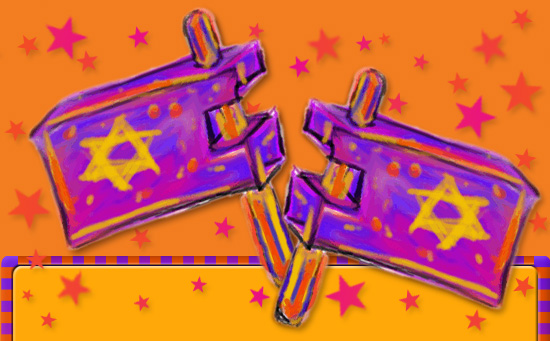
All too often, we relegate Purim to the children in our community. But it’s not just for kids. I’ve been to some quite wonderful adult Purim celebrations. We’re never too old to dress up and enjoy this holiday. After all, the themes, the characters and the story of Purim have much to add to our lives. Purim is a joyous affirmation of Jewish survival despite the great odds that confronted Esther and her Uncle Mordecai. The story of Purim is a story of people taking charge of their own destiny and it reminds us that celebration is essential in our sometimes difficult and complex lives. We are given the opportunity to transcend, at least temporarily, the seriousness and busyness of everyday existence and are magically transported to a world of drama, revelry, and ancient tales of tribulation and triumph.

So this year, celebrate Purim! Laugh, dress in costume, make hamantaschen and send sweets to friends and family. Let yourself be lighthearted and remember the sweetness and joys of life. After all, you should be happy – It’s Adar!
Wednesday, February 1, 2012
Tree of Life - Tu B'shevat and Rejewvenation
Tu Bishevat - the fifteenth day of the month of Shevat in the Jewish calendar, falls this year on February 8th. Tu Bishevat is the New Year of the trees. We rejoice in the fruit of the tree and the fruit of the vine. In the Talmud there is a legend about Honi, who came upon an old man planting a carob tree. When Honi saw the old man, he at once questioned the old man’s actions, saying, “Foolish man, do you think you will still be alive to eat of the fruit of this tree?” The old man replied, “I found trees in the world when I was born. My grandparents planted them for me. Now I am planting for the generations that will come after me.” The story goes on to tell us that Honi fell into a deep sleep, from which he did not awaken for 70 years. When he awoke he was surprised to see an old man picking the fruit from a fully grown carob tree. When he inquired of the old man, “Are you the man who planted this tree?” the old man answered, “My grandfather planted it for me.” (Talmud Bavli, Ta’anit 23a)
The Talmud says that the root is the soul and the branch is the body. Just so, there is a branch of the tree of life representing each and every Jew. How marvelous are these branches, for while nourished by the same roots, the fruit of every branch is completely different. Our rabbis taught that one who sees a multitude of Jews should recite this blessing: “Blessed is the all-wise and mysterious God, for each person’s opinion is different and each person’s appearance is different,” and yet they are all Jews (Talmud Bavli, Berachot 58a). United by the tree of life, the Torah, we each create our own Jewish life.
All too often these days, however, too many of us feel that our active participation in Jewish life and Jewish community does not matter. I am saddened when I hear this phrase: “As long as I feel Jewish, what does it matter if I do anything or not.” I am saddened because it is not enough to “feel” like a branch of the tree of life. Judaism is about doing, and living Jewishly. A feeling is intangible. It cannot be transmitted or passed to another without real, physical contact. The fruit of Jewish life means seeing, tasting, touching, smelling, and acting in order to live as a Jew and to have an impact on the world around us. We are obligated to live Jewishly in order to fulfill the commandments and to sow the seeds of future Jewish living.

Tu Bishevat calls us to action because it asks us to plant. We too are like trees, requiring constant nourishment in order to flourish and grow. While certain aspects of our own trees of life can take nourishment from any ground, there is a second system, a root which reaches hungrily for the teaching of Torah. Being Jewish requires constant rejewvenation from the soil of Torah. We are commanded to take action and participate in doing Jewish life in order to flourish and grow. We have planted and transplanted this tree time and again. May we keep the soil fertile that our faith in God and our Jewish acts may grow. May we strengthen our roots with the past, and may our branches reach towards the future to bear sweet fruit.
The Talmud says that the root is the soul and the branch is the body. Just so, there is a branch of the tree of life representing each and every Jew. How marvelous are these branches, for while nourished by the same roots, the fruit of every branch is completely different. Our rabbis taught that one who sees a multitude of Jews should recite this blessing: “Blessed is the all-wise and mysterious God, for each person’s opinion is different and each person’s appearance is different,” and yet they are all Jews (Talmud Bavli, Berachot 58a). United by the tree of life, the Torah, we each create our own Jewish life.
All too often these days, however, too many of us feel that our active participation in Jewish life and Jewish community does not matter. I am saddened when I hear this phrase: “As long as I feel Jewish, what does it matter if I do anything or not.” I am saddened because it is not enough to “feel” like a branch of the tree of life. Judaism is about doing, and living Jewishly. A feeling is intangible. It cannot be transmitted or passed to another without real, physical contact. The fruit of Jewish life means seeing, tasting, touching, smelling, and acting in order to live as a Jew and to have an impact on the world around us. We are obligated to live Jewishly in order to fulfill the commandments and to sow the seeds of future Jewish living.
Tu Bishevat calls us to action because it asks us to plant. We too are like trees, requiring constant nourishment in order to flourish and grow. While certain aspects of our own trees of life can take nourishment from any ground, there is a second system, a root which reaches hungrily for the teaching of Torah. Being Jewish requires constant rejewvenation from the soil of Torah. We are commanded to take action and participate in doing Jewish life in order to flourish and grow. We have planted and transplanted this tree time and again. May we keep the soil fertile that our faith in God and our Jewish acts may grow. May we strengthen our roots with the past, and may our branches reach towards the future to bear sweet fruit.
Friday, December 3, 2010
Ma’achil R’eivim - It is a Mitzvah to Feed the Hungry
As we move into the dark of December, illuminated by the Chanukah lights, many are busy with holiday plans, galas, and all the festivities that go along with them. We often worry this time of year about increasing waistlines, indigestion, and the diet and exercise program we will reluctantly start on January 1st. Yet, while so many are celebrating, while we enjoy the parties and the delicacies, the 2010 Hunger in America Study by Feeding America shows that the demand for food assistance by Hoosier families is increasing.
In a recent interview, Katy Bunder, the Executive Director of Food Finders, reported that: “The demand this past year has been nearly overwhelming. We hear more and more that people in our service area are suffering. Kids are going to bed hungry, families have no money for food after paying utilities and rent and seniors are having to choose to buy medication or to eat. We just believe there is more we can do.”
“Local statistics indicate that Food Finders serves an estimated 10,000 different clients per week in programs throughout the mid north Indiana service area. The survey samples also indicate that 33.9 % of all households seeking food assistance have at least one adult working. 27% of all adults had lost their jobs in the previous 11 months. Women comprise 64.3% of all clients at program sites and 43.1% of the households served have children younger than 18 years of age. In addition, results also show that 99% of clients have a place to prepare meals and more than half live in traditional households. 99% of clients at emergency food programs are US citizens and 73% of emergency food clients in Food Finders service areregistered voters. More than 50% of clients reported having very low food security which indicates one or more members either skip meals or experience increased hunger due to a lack of adequate resources for food.”

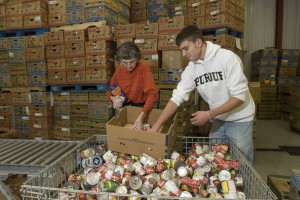
There are many organizations that help to fight hunger, and I encourage you to continue to support organizations that you have donated to in the past. Locally we have several food drives each year to support Food Finders. You can make donations of either foodstuffs or monetary donations: Food Finders Food Bank, Inc., 50 Olympia Ct., Lafayette, In 47909-5182 or donate online.

Nationally, MAZON: A Jewish Response to Hunger is a national nonprofit organization that allocates donations from the Jewish community to prevent and alleviate hunger among people of all faiths and backgrounds.
Each year, MAZON ( Hebrew for “sustenance”) grants over $4 million to more than 300 carefully screened hunger-relief agencies, including emergency food providers, food banks, multi-service organizations and advocacy groups that seek long-term solutions to the hunger problem. Many Jews now honor the Jewish tradition of not eating until you have provided for the poor by donating at least 3% of the cost of their life-cycle celebrations – weddings, bar mitzvahs, anniversaries, etc. Donate at: MAZON: A Jewish Response to Hunger, PO Box 894765 Los Angeles, CA 90189-4765 or online.

Our tradition teaches that we are to say a blessing (HaMotzi) before we eat a meal, and then to say a blessing (Birkat HaMazon) after we have eaten. Our sages asked, why is it necessary to recite a blessing after the meal when we have already thanked God for our food before the meal? We are taught that when we are hungry it is easy to be thankful for food. It is when we have been satisfied that is easy to take sustenance for granted and when we have finished eating that it is even more difficult to remember to be grateful. May we learn that sustenance is not something to be taken for granted, and may we help in being God’s partner by seeing to it that those in need know the feeling of a full stomach, rather than the pangs of hunger.
In a recent interview, Katy Bunder, the Executive Director of Food Finders, reported that: “The demand this past year has been nearly overwhelming. We hear more and more that people in our service area are suffering. Kids are going to bed hungry, families have no money for food after paying utilities and rent and seniors are having to choose to buy medication or to eat. We just believe there is more we can do.”
“Local statistics indicate that Food Finders serves an estimated 10,000 different clients per week in programs throughout the mid north Indiana service area. The survey samples also indicate that 33.9 % of all households seeking food assistance have at least one adult working. 27% of all adults had lost their jobs in the previous 11 months. Women comprise 64.3% of all clients at program sites and 43.1% of the households served have children younger than 18 years of age. In addition, results also show that 99% of clients have a place to prepare meals and more than half live in traditional households. 99% of clients at emergency food programs are US citizens and 73% of emergency food clients in Food Finders service areregistered voters. More than 50% of clients reported having very low food security which indicates one or more members either skip meals or experience increased hunger due to a lack of adequate resources for food.”
There are many organizations that help to fight hunger, and I encourage you to continue to support organizations that you have donated to in the past. Locally we have several food drives each year to support Food Finders. You can make donations of either foodstuffs or monetary donations: Food Finders Food Bank, Inc., 50 Olympia Ct., Lafayette, In 47909-5182 or donate online.

Nationally, MAZON: A Jewish Response to Hunger is a national nonprofit organization that allocates donations from the Jewish community to prevent and alleviate hunger among people of all faiths and backgrounds.
Each year, MAZON ( Hebrew for “sustenance”) grants over $4 million to more than 300 carefully screened hunger-relief agencies, including emergency food providers, food banks, multi-service organizations and advocacy groups that seek long-term solutions to the hunger problem. Many Jews now honor the Jewish tradition of not eating until you have provided for the poor by donating at least 3% of the cost of their life-cycle celebrations – weddings, bar mitzvahs, anniversaries, etc. Donate at: MAZON: A Jewish Response to Hunger, PO Box 894765 Los Angeles, CA 90189-4765 or online.

Our tradition teaches that we are to say a blessing (HaMotzi) before we eat a meal, and then to say a blessing (Birkat HaMazon) after we have eaten. Our sages asked, why is it necessary to recite a blessing after the meal when we have already thanked God for our food before the meal? We are taught that when we are hungry it is easy to be thankful for food. It is when we have been satisfied that is easy to take sustenance for granted and when we have finished eating that it is even more difficult to remember to be grateful. May we learn that sustenance is not something to be taken for granted, and may we help in being God’s partner by seeing to it that those in need know the feeling of a full stomach, rather than the pangs of hunger.
Subscribe to:
Posts (Atom)

 Posts
Posts