Showing posts with label WRJ. Show all posts

Sunday, January 6, 2013

Happy Birthday Women of Reform Judaism

2013 marks a significant birthday for Reform Judaism – the Women of Reform Judaism (WRJ), formerly known as the National Federation of Temple Sisterhoods (NFTS) celebrates its centennial.

The first Jewish Sisterhood of Personal Service was organized in New York’s Reform Temple Emanu-El by Rabbi Gustav Gottheil in the late 1880s. While women now had a place in the sanctuary thanks to the innovations of Reform Judaism and the abolishment of the women’s section, women did not have an active role in the spiritual leadership and congregational governance.  Women’s groups offered leadership in religious schools, decorating the temple and maintaining the temple kitchen.  For the most part, governance positions and access to membership were not open to women until 1920 when after the passage of the 19th Amendment, granting women the right to vote, Reform congregations began to offer formal membership to women who were unmarried or were not widows and sisterhood presidents were given the leadership opportunity to serve on congregational governance boards.

The National Federation of Temple Sisterhoods (NFTS) was formally organized as a national movement in 1913 at a special meeting in Cincinnati.  Rabbi George Zepin of the Union for American Hebrew Congregations and Carrie Simon, a civic leader and Washington Hebrew Congregation’s rebbetzin, spearheaded the creation of the NFTS as a national organization, proclaiming that “that the increased power which has come to the modern American Jewess ought to be exercised in congregational life.” At the meeting in Cincinnati, Carrie Simon was elected founding president. Carrie Simon envisioned NFTS’ mission as carrying the banner of religious spirit and strengthening the congregation.  Conservative and Orthodox women, originally invited to be a part of NFTS, would found their own organizations with a decade of NFTS’s beginnings.


Sisterhoods actively assumed responsibility for many school, temple, and communal activities.  Its national committee on religious schools funded textbooks for child and adult education, were founding supporters of NFTY, our Reform youth movement. NFTS brought rabbinical students fleeing Germany to the US, raised scholarship funds for rabbinical students, and solely funded a dormitory at Hebrew Union College.  NFTS was also a founder of the Jewish Braille institute, and many sisterhood women transcribed articles and books into Braille.

NFTS leaders called for the experiment of electing women to synagogue boards; called upon its members to lead summer services in the absence of vacationing rabbis, and instituted Sisterhood Sabbath, a day when, in some congregations, women could lead the service and preach to the entire congregation. Today we take many of these contributions for granted, even as many orthodox and conservative congregations are still wrestling with and questioning the place of women in leadership. NFTS recorded important experiences in women’s participation in the synagogue —the first time a woman trustee sat on the pulpit during services, the first time a woman read scripture on Yom Kippur, and would later point to these examples of successful female religious leadership as “a revelation of what the women may do if they ever enter the rabbinate.”

Today, the Women of Reform Judaism has grown from 49 sisterhoods with 9,000 members in 1913 to more than 65,000 members in 500 affiliates in the US, Canada and twelve other countries. The WRJ continues its work building upon the foundation its foremothers started 100 years ago.

Happy Birthday Women of Reform Judaism!

(cross posted at Kol Isha, the blog of the Women's Rabbinic Network)   

Sunday, July 8, 2012

An Inspiring Quest

A little more than a month ago I received an email that read: “Hello Rabbi Pollack, Once again I am writing you about my quest of meeting all the female Rabbis that contributed to the Women’s Torah Commentary . So far I have met 36 Rabbis and look forward to meeting you. I am going to be in your area the first week of July 2012 and was hoping that you would be available to meet with me and sign my book…. Bonny Katz.”

As it happened this week I am serving on faculty at our regional URJ camp, GUCI, so when Bonny and her husband Ian drove through, they honored me my stopping here to meet and I signed her book. This is a quest she has been on for quite some time. It’s not easy to meet up with 54 female rabbis who live all across North America. I was really thrilled and honored to be a part of Bonny’s quest. It has been very exciting to be a part of a Torah commentary that has all female rabbinic contributors. And as one of the writers, I hope to be able to inspire women and men, with our teachings on the parashiot.

At camp this session our theme is “Partners with God”.  We’ve been looking at this from many aspects, and one of the shiurim (lessons) this week that particularly resonated with our campers is the concept of what it means to be a leader and a role model.  We examined the idea of being a great leader, but not a great role model, and what it takes to be a role model, from a Jewish perspective, not just in the Torah, but how we can strive to live our own lives as role models.

As rabbis, naturally, we are expected to be role models, in all aspects, not just in Jewish practice, but in everything that we do.  One of the great things about being at camp is that I sit with campers in programs, at meals, in shiur, and get out there and do activities with them in the camp setting, not in an office, or behind a desk.  We’re all sweating together this week in shorts and t-shirts in the 100 degree heat, we’re dancing at song session, and cheering, praying together, eating together, and having conversations that are meaningful and important – about God and Judaism, and what it means to be a Jew today, especially in places where there aren’t many other Jewish kids in their schools.  The other night I led a lights out program for cabin 3.  I brought my guitar and sang some of my favorite songs, and the girls asked me questions – how long have you been a rabbi, what is the scariest thing that ever happened to you, what is your favorite camp song, who are your role models. The kinds of questions that maybe they don’t ask their own rabbi at home, but here at camp, these are the important questions.

The girls of cabin 3 didn’t seem at all surprised to have a female rabbi doing their lights out program, probably because they see both female and male rabbis at camp every year.  It’s something that I still find amazing, because when I was their age, there weren’t many female rabbis at all.  In Tefillah (worship services) this week, I’ve also been reflecting on how much stayed the same and how much has changed.  We are singing many of the same melodies for prayers that we sang at camp, even as newer beautiful melodies have been added.  Back when I was a camper, there was a vigorous debate over whether or not to include the Imahot (matriarchs) in the Avot prayer.  Today, the Avot v’Imahot is a given. The debate today is over whether Leah comes before Rachel in the liturgy.  All of this made Bonny’s quest even more amazing and inspiring for me.

When I was a camper Bonny’s quest wouldn’t even have been possible. There were not enough female rabbis back then to have had 54 writers on the parashiot.  The questions   we are asking and the discussions we are having today may be some of the same questions and discussions, but they are different because women’s voices are added to the mix.  As I hugged her before she left, I told Bonny that I want to hear more about her journey as it continues – I know she will have some wonderful stories to tell.

(cross posted at Kol Isha, the blog of the Women's Rabbinic Network)

Tuesday, June 5, 2012

40 Years - A Journey of Transformation

For the closing program this Spring  our Temple Israel Sisterhood held a Woman of Valor Tea, honoring five women of distinction and dedication to our congregation.  At the very end of the celebration I was surprised with a commemorative Lucite plaque, honoring me for ten years at Temple Israel.  As congratulations were shared, a leader of our congregation remarked on how much she and our Temple family appreciated having me as the rabbi, as a leader and teacher in the community. Perhaps more surprising to me, she recalled the complex and fraught discussions and debate that had surrounded the decision to hire me these ten years ago, because I would be their first woman rabbi.

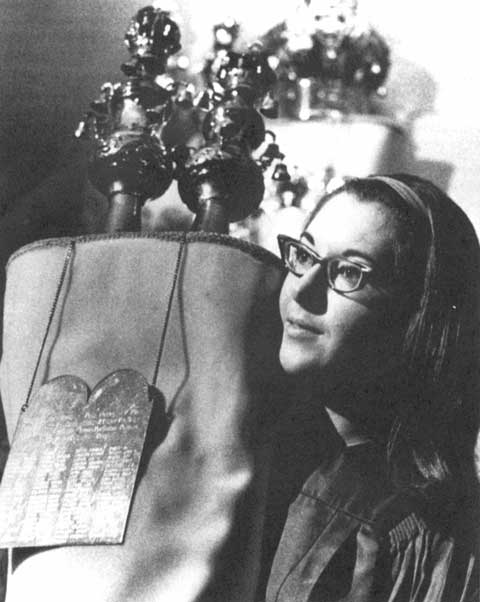
This June marks a momentous event in Jewish history.  On June 3, 1972, forty years ago, Rabbi Sally Priesand stood on the bima at Plum Street Temple in Cincinnati, Ohio, and was ordained as the first female rabbi.  On that same date 18 years ago, June 3, 1994, I stood on that same bima at Plum Street Temple and took my place in the line of  611 female Reform rabbis that have since followed in Rabbi Priesand’s path.

Rabbi Sally Priesand, 1972


Forty is a significant number in Jewish tradition.  When Noah built the ark, the rain lasted for 40 days and nights. The Jewish people wandered for 40 years in the wilderness before entering the land of Israel. Moses spent 40 days and nights up on Mt. Sinai to receive Torah. The spies that Moses sent out to explore the land were there for 40 days. One is only considered old and wise enough to study kabbalah, Jewish mysticism, at the age of 40.  A mikveh must be filled with 40 seahs of water. According to Rabbi Judah Loew, the Maharal of Prague(16th century), the number 40 has the ”power to transform one’s spiritual state. ” 40 is also considered a number of completion.  The number of days that it takes an embryo to form in its mother’s womb according to the Talmud is 40 days (Talmud Bavli Yevamot 69b).  While science today would disagree with that idea, we do know that gestation of a human being is 40 weeks. And  in the Mishnah (Shabbat 7:2) there is a list of 39 melachot or categories of labor or creative work that are forbidden on Shabbat, described as “40 less one”. These categories correspond to the 39 modes of constructive labor it took to build the Mishkan in the wilderness. And on Shabbat we rest from those labors, step out of this physical work, and make room for the spiritual fulfillment of Shabbat. Why 40 less one?  The sages teach that 40 is the number of completion, that these 39 categories of physical  labor it took to build the Mishkan were not complete without the spiritual labor to bring Shabbat into the Mishkan. These 39 categories of work parallel the work that went into the creation, with the one exception of the spiritual dimension of creation, and that is what completes the work, hence the 40th is the completion, the spiritual dimension.

While I would hesitate to say that we have arrived at a place of completion for women’s status in Jewish life, certainly, 40 years of women’s rabbinic leadership have powerfully transformed the Jewish world’s spiritual state.

As I write this message, Rabbi Miri Gold has just been recognized as the first non-orthodox rabbi of a congregation in Israel. This decision paves the way for other Reform and Conservative rabbis in Israel, both men and women, to receive government recognition and a salary, in the same way that over 4000 orthodox rabbis are recognized. Just a few weeks ago, Rabbi Alona Lisitsa became the first Israeli Reform Rabbi to sit on a municipal religious council nominated by the Minister of Courts (after an injuction by the Supreme Court). Two years ago, Rabba Sara Hurwitz became the first Orthodox female rabbi.

Forty years ago, who could have imagined orthodox women learning and teaching Talmud, or leading tefillah (prayer) in orthodox egalitarian minyanim.
But we still have along way to go before we get to the promised land where we can all stand at Sinai together. 40 years of work and journeying in the wilderness have led us as a Jewish family to a new place and a new spiritual state but we are still on a journey. As Judith Plaskow writes “We must expand the notion of Torah to encompass not just the five books of Moses and traditional Jewish learning, but women’s words, teachings, and actions hitherto unseen. To expand Torah, we must reconstruct Jewish history to include the history of women, and in doing so alter the shape of Jewish memory.” (Judith PlaskowStanding Again at Sinai, p. 28)

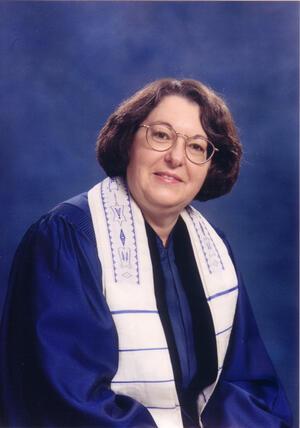
Rabbi Sally Priesand
Judaism has changed and continues to change because of the work and leadership of women rabbis. As we look forward to the next steps on the journey, we wish Rabbi Sally Priesand Mazal Tov and Todah Rabbah!  Yeshar Kochech!

(cross posted on  Kol Isha, the blog of the Women's Rabbinic Network)