The month of Elul, the month leading up to the High Holidays, which begins this year on August 7, 2013, is a time for rethinking, self-reflection, and meditation. During this month it is customary that every Jew - not just scholars or rabbis - take time to join in Jewish study, read the Bible, and rethink and take stock of his or her life. Why 40 days of preparation? This custom is explained in relationship to the earliest of reconciliations between the Jewish people and God: the 40 days which Moses spent on Mount Sinai after destroying the first set of the Ten Commandments. Moses had come down the mountain and saw the people with the golden calf. He punished the people, destroyed the calf and then went back up the mountain to fast and pray for 40 days. These ended - on Yom Kippur - when Moses received the second set of Ten Commandments from God as a sign of God's forgiveness and reconciliation with the Jewish people. In identifying the 40 days Moses spent on the mountain with the days leading up to Yom Kippur, the Jewish community tries to spend those 40 days as Moses did - in prayer and study and in rethinking one's life in order to merit God's forgiveness. The month of Elul is 30 days long, and there are ten days from the first of Tishrei to Yom Kippur. So, the 40 days begin with the first of Elul.
There are two major customs associated with these forty days. Each morning of the month of Elul, with the exception of Shabbat and the last day of Elul, the shofar is blown. This is meant to be a spiritual wakeup call, and is also a reminder of the shofar blowing that will be heard on Rosh Hashanah. The second custom is the reading of Psalm 27 at every service. This plea to God for help and deliverance from our enemies is understood at this time of year as a plea for deliverance from our own internal enemies, from the challenges we face daily that may have caused us not to be true to ourselves. As Elul comes to an end, our spiritual preparation, prayers and self-reflection intensify with special prayers of Selichot, prayers of asking forgiveness from God and for spiritual healing.
For your own spiritual preparation leading up to the High Holidays:
Jewels of Elul
Seasons of Our Joy - Arthur Waskow
The Jewish Holidays, A Guide and Commentary - Michael Strassfeld
Days of Awe - Shmuel Yosef Agnon
Preparing Your Heart for the High Holy Days: A Guided Journal by Kerry M. Olitzky and Rachel T. Sabath
Showing posts with label 40. Show all posts
Showing posts with label 40. Show all posts
Monday, August 5, 2013

Tuesday, June 5, 2012
40 Years - A Journey of Transformation
For the closing program this Spring our Temple Israel Sisterhood held a Woman of Valor Tea, honoring five women of distinction and dedication to our congregation. At the very end of the celebration I was surprised with a commemorative Lucite plaque, honoring me for ten years at Temple Israel. As congratulations were shared, a leader of our congregation remarked on how much she and our Temple family appreciated having me as the rabbi, as a leader and teacher in the community. Perhaps more surprising to me, she recalled the complex and fraught discussions and debate that had surrounded the decision to hire me these ten years ago, because I would be their first woman rabbi.
This June marks a momentous event in Jewish history. On June 3, 1972, forty years ago, Rabbi Sally Priesand stood on the bima at Plum Street Temple in Cincinnati, Ohio, and was ordained as the first female rabbi. On that same date 18 years ago, June 3, 1994, I stood on that same bima at Plum Street Temple and took my place in the line of 611 female Reform rabbis that have since followed in Rabbi Priesand’s path.
Forty is a significant number in Jewish tradition. When Noah built the ark, the rain lasted for 40 days and nights. The Jewish people wandered for 40 years in the wilderness before entering the land of Israel. Moses spent 40 days and nights up on Mt. Sinai to receive Torah. The spies that Moses sent out to explore the land were there for 40 days. One is only considered old and wise enough to study kabbalah, Jewish mysticism, at the age of 40. A mikveh must be filled with 40 seahs of water. According to Rabbi Judah Loew, the Maharal of Prague(16th century), the number 40 has the ”power to transform one’s spiritual state. ” 40 is also considered a number of completion. The number of days that it takes an embryo to form in its mother’s womb according to the Talmud is 40 days (Talmud Bavli Yevamot 69b). While science today would disagree with that idea, we do know that gestation of a human being is 40 weeks. And in the Mishnah (Shabbat 7:2) there is a list of 39 melachot or categories of labor or creative work that are forbidden on Shabbat, described as “40 less one”. These categories correspond to the 39 modes of constructive labor it took to build the Mishkan in the wilderness. And on Shabbat we rest from those labors, step out of this physical work, and make room for the spiritual fulfillment of Shabbat. Why 40 less one? The sages teach that 40 is the number of completion, that these 39 categories of physical labor it took to build the Mishkan were not complete without the spiritual labor to bring Shabbat into the Mishkan. These 39 categories of work parallel the work that went into the creation, with the one exception of the spiritual dimension of creation, and that is what completes the work, hence the 40th is the completion, the spiritual dimension.
While I would hesitate to say that we have arrived at a place of completion for women’s status in Jewish life, certainly, 40 years of women’s rabbinic leadership have powerfully transformed the Jewish world’s spiritual state.
As I write this message, Rabbi Miri Gold has just been recognized as the first non-orthodox rabbi of a congregation in Israel. This decision paves the way for other Reform and Conservative rabbis in Israel, both men and women, to receive government recognition and a salary, in the same way that over 4000 orthodox rabbis are recognized. Just a few weeks ago, Rabbi Alona Lisitsa became the first Israeli Reform Rabbi to sit on a municipal religious council nominated by the Minister of Courts (after an injuction by the Supreme Court). Two years ago, Rabba Sara Hurwitz became the first Orthodox female rabbi.
Forty years ago, who could have imagined orthodox women learning and teaching Talmud, or leading tefillah (prayer) in orthodox egalitarian minyanim. But we still have along way to go before we get to the promised land where we can all stand at Sinai together. 40 years of work and journeying in the wilderness have led us as a Jewish family to a new place and a new spiritual state but we are still on a journey. As Judith Plaskow writes “We must expand the notion of Torah to encompass not just the five books of Moses and traditional Jewish learning, but women’s words, teachings, and actions hitherto unseen. To expand Torah, we must reconstruct Jewish history to include the history of women, and in doing so alter the shape of Jewish memory.” (Judith Plaskow, Standing Again at Sinai, p. 28)
Judaism has changed and continues to change because of the work and leadership of women rabbis. As we look forward to the next steps on the journey, we wish Rabbi Sally Priesand Mazal Tov and Todah Rabbah! Yeshar Kochech!
(cross posted on Kol Isha, the blog of the Women's Rabbinic Network)
This June marks a momentous event in Jewish history. On June 3, 1972, forty years ago, Rabbi Sally Priesand stood on the bima at Plum Street Temple in Cincinnati, Ohio, and was ordained as the first female rabbi. On that same date 18 years ago, June 3, 1994, I stood on that same bima at Plum Street Temple and took my place in the line of 611 female Reform rabbis that have since followed in Rabbi Priesand’s path.
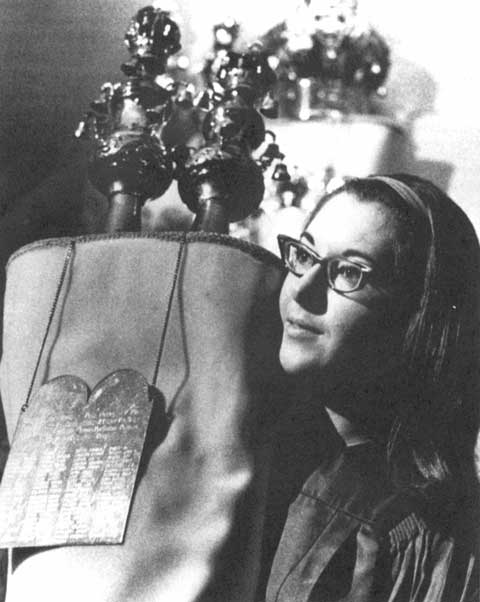 | |||
| Rabbi Sally Priesand, 1972 |
While I would hesitate to say that we have arrived at a place of completion for women’s status in Jewish life, certainly, 40 years of women’s rabbinic leadership have powerfully transformed the Jewish world’s spiritual state.
As I write this message, Rabbi Miri Gold has just been recognized as the first non-orthodox rabbi of a congregation in Israel. This decision paves the way for other Reform and Conservative rabbis in Israel, both men and women, to receive government recognition and a salary, in the same way that over 4000 orthodox rabbis are recognized. Just a few weeks ago, Rabbi Alona Lisitsa became the first Israeli Reform Rabbi to sit on a municipal religious council nominated by the Minister of Courts (after an injuction by the Supreme Court). Two years ago, Rabba Sara Hurwitz became the first Orthodox female rabbi.
Forty years ago, who could have imagined orthodox women learning and teaching Talmud, or leading tefillah (prayer) in orthodox egalitarian minyanim. But we still have along way to go before we get to the promised land where we can all stand at Sinai together. 40 years of work and journeying in the wilderness have led us as a Jewish family to a new place and a new spiritual state but we are still on a journey. As Judith Plaskow writes “We must expand the notion of Torah to encompass not just the five books of Moses and traditional Jewish learning, but women’s words, teachings, and actions hitherto unseen. To expand Torah, we must reconstruct Jewish history to include the history of women, and in doing so alter the shape of Jewish memory.” (Judith Plaskow, Standing Again at Sinai, p. 28)
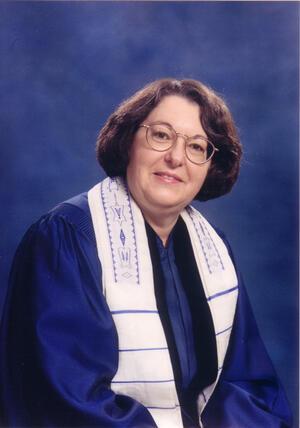 |
| Rabbi Sally Priesand |
(cross posted on Kol Isha, the blog of the Women's Rabbinic Network)
Subscribe to:
Posts (Atom)

 Posts