Showing posts with label Reform Judaism. Show all posts

Tuesday, July 29, 2014

My Heart Is In the East

I am writing as I sit outside under the trees at Goldman Union Camp Institute (GUCI). Camp is a place that is in many ways sheltered from the rest of the world, it is a place of peace, where lifelong friendships are formed, and Jewish souls are nurtured. But this summer I as I sit under the trees, teach and learn, connect with colleagues and friends, sing songs and watch campers grow, I am deeply troubled.

Since arriving here, Israel has entered into a ground war in Gaza, to protect her citizens from the non-stop barrage of missile attacks from Hamas. Operation Protective Edge began just a few weeks before I came to camp, and in a short time it became clear that the Iron Dome system would not be enough to halt the attacks. Israel has agreed to multiple cease fires, Hamas refused to stop shooting. This forced Israel to consider sending troops into Gaza.  After completely withdrawing from Gaza in 2005, going back into Gaza for a ground operation was not a decision made lightly.  As Israel calls phones and drops leaflets to warn Gazans to take shelter, Hamas continues to urge its citizens to ignore the IDF’s warnings, to be human shields for the warfare, and continues to place armaments and rocket launchers in schools, hospitals, and mosques. The United Nations continues to condemn Israel for her actions, even as they admit to discovering rockets placed deliberately in school buildings, and then amazingly, handing over those same rockets to the Palestinian leadership.

Since entering Gaza, Israel has discovered 31 tunnels so far with more than 60 shafts leading to them.  These tunnels were built by Hamas using forced child labor.  More than 160 Palestinian children died constructing them. Israel us reporting that these tunnels are full of explosives, missiles and other weaponry. These tunnels were built as part of a long term large scale plan to launch a massive assault on Israeli civilians to take place just two months from now, on Rosh Hashanah. This surprise attack was planned to send 200 Hamas fighters through the tunnels under the border from Gaza into Israel, wearing Israeli army uniforms. Then the plan was to take control of kibbutzim and other communities while killing and kidnapping Israel civilians.

Antisemitic acts of violence and demonstrations are occurring with increasing frequency. These reports of violence and anti-Israel sentiment, which simply put is anti-Jewish sentiment, are frightening. There have been riots and anti-semitic mobs in Paris, Calgary, and Belfast and anti-Israel rioters and vandalism in Chicago, Connecticut and Boston.

Here at camp, on this past Shabbat, our Israeli counselors shared prayers for peace, and prayers for safety for their families and friends, and for those in the Israeli Defense Forces.  The Israeli counselors have shed more than a few tears and I can see worry on their faces, but for the most part, here at camp, we are immersed in providing all of the campers with a great environment for learning about themselves and their Jewish identity.

Our Israeli Shlichim Share Prayers for Peace
Friends and colleagues in Israel have been sharing their firsthand experiences, of traveling in Israel, running to bomb shelters, and going about their daily lives. I am proud of our NFTY (North American Federation of Temple Youth) staff and the URJ, who were able to continue touring with our teen groups on our Israel trips this summer and keeping them safe. I am proud of my CCAR rabbinic colleagues flew to Israel on a quickly arranged mission of support. They are taking shelter in stairwells and bomb shelters as they visit the border towns adjacent to Gaza, and deliver care packages of toiletries, energy bars, and other items for lone soldiers. Aliyah flights to Israel have continued, and despite arriving in a war zone, not one family backed out of their plans to make aliyah.

It is a very troubling time. Many of us feel powerless to be able to do anything. Some of us feel conflicted about what is happening in Israel and what is happening in Gaza. It is certainly disturbing that so many children on both sides of the conflict are again living with fear. And there are people suffering.  If you want to do something, below are some ways to support Israel and those who are living with daily missile attacks:

Israel Movement for Progressive Judaism (Reform Judaism in Israel - IMPJ) through the World Union for Progressive Judaism (WUPJ), 633 Third Ave. 7th floor NYC 10017. The WUPJ and IMPJ are doing great work to assist those impacted and to keep lines of communication open between Israelis and Arab communities in Israel.


Friends of the IDF - Friends of the IDF is in Israel supplying the IDF soldiers on the frontlines with snack packages, toiletry kits, and underwear.  


Silence the Sirens -  The URJ and Jewish Federations of North America are collecting funds to provide emergency aid and alleviate the pain and suffering of our Israeli brothers and sisters.


Yad Eliezer has distributed food and supplies to residents of Southern Israel living under a constant barrage of rockets with food and treats for families stuck at home in bomb shelters.

The Jaffa Institute, which looks after children across South Tel Aviv and Jaffa, have relocated 170 at-risk children from communities hit hardest from rockets - donations go to recreational activities, learning materials, food and treatment.


Natal is an organization that provides hotlines for people who are suffering anxiety and need to speak with someone - both for people in the North and the whole of Israel.

Friday, January 18, 2013

Remembering Dr. Martin Luther King Jr.

This week I had the privilege of participating in the Women’s Rabbinic Network  convention in Memphis TN. Our bi-annual convention of Reform women rabbis from across North America (and one colleague from the former Soviet Union who now lives in Israel), gathered for 4 days of rich learning, beautiful praying and singing, and sisterhood and support. I was privileged to work on planning and leading the opening and closing ritual moments and part of our tefillot (worship) together.
 
As part of our gathering in Memphis, we went to the Lorraine Hotel where Rev. Dr. Martin Luther King Jr. was assassinated on the evening of April 4, 1968 and the Civil Rights museum. It was very moving to be in Memphis during the week of Dr. King’s birthday. Had he lived, he would have been 84 years old. As we stood together in Memphis at that place where we all lost so much,  we reflected on his life and legacy, on what a rare gift he gave to the world with his courage and his passion.

On Tuesday, Dr. King’s birthday, there was an ice storm in Memphis.  Many of the downtown area shops and businesses closed, sending their workers home early.  At dinner we rose and gave a standing ovation to the hotel wait staff, who had not gone home early, and were there serving our meal, and tending to the needs of hotel guests. (full disclosure, we do this at every one of our WRN conventions, because just as we thank God for food in the Motzi and Birkat hamazon, we are mindful that it is through many hands that food comes to our table each and every day.) As we stood, I was reminded of why Dr. King had gone to Memphis in April of 1968 -  sanitation workers in Memphis had staged a walkout to protest unequal wages and working conditions.  Black workers were paid significantly less than whites and received no pay if they stayed home in and weather, while their white counterparts were paid. So many of them were compelled to work in rain and snow storms. King had come to Memphis to prepare for a March the following Monday in support of these striking workers.

Our parashah this week is parashat Bo – “Bo el Paroah”, begins the text, as God says to Moses, “Go to Pharoah”, for I have hardened his heart. God tells Moses to go to Pharoah, his heart hardened, and ask Pharoah to let God’s people go forth from slavery to freedom. It is the message of God to Moses and the teaching of God in Exodus that led Dr. King to have the faith to dream of the end of racial segregation and racial discrimination and achieve equality through the civil rights movement.

Moses does as God tells him and goes to Pharoah demanding that Phaorah let the Jewish people go. But Pharaoh, his heart hardened, responds to Moses’ requests by rebuking him and increasing their workload, making life harder for the Jewish slaves. When the civil rights movement began to gain support, southern whites responded by making the lives of black Americans more difficult, threatening and assaulting civil rights leaders with violence, ultimately taking Dr. King’s life.
Many Jews felt compelled to respond to the fight against racial segregation and discrimination in America. We remembered the teachings of Torah and the call of the rabbis – “you shall not stand by while your neighbor bleeds”, “remember the poor and the stranger, for you were strangers in the land of Egypt”. We knew what it was like to experience discrimination and hatred. So many Jews felt called by faith and familiarity to serve in the cause of racial justice and equality.


On the march from Selma to Montgomery in March 1965, Rabbi Abraham Joshua Heschel walked in the front row with King, a spiritual partner in the struggle against racism. On a conference table in the Union for Reform Judaism’s Religious action Center building, black and Jewish lawyers drafted the Civil Rights Act of 1964 and the Voting Rights Act of 1965. The president of the NAACP at the time was Kivie Kaplan, a prominent member of the Reform movement’s social action commission. Today, Rabbi David Saperstein, the head of the URJ’s Religious Action Center in Washington, is the only non-African American on the board of the NAACP.

This coming August marks 50 years since Rev. King’s galvanizing, inspirational speech delivered on the steps of the Lincoln Memorial in Washington DC and 150 years since President Lincoln signed into law the Emancipation Proclamation.

50 years after Dr. King spoke of the dream that he had for this great country, civil rights and the fight for equality remain an important issue.  Dr. King’s dream has not yet been achieved when we continue to see efforts to disenfranchise voters.  Dr. King’s dream has not yet been achieved when there is still discrimination in this country towards people of different colors, religions, or ethnic origins.  Dr. King’s dream has not yet been achieved when there is discrimination against people because of their sexual orientation.  But he had the courage and the faith and the conviction to go forward, and his legacy still burns clearly today as we celebrate his birthday this weekend.  He had the courage and faith that Moses had to “Bo El Paroah”, to go to Phaorah and say “let me people go.”  His work in the world is now ours to do. As our rabbis teach in Mishna Pirke Avot 2:20-21 “Lo alecha hamlacha ligmor, vlo atah ben chorin lhibateil mimena. “It is not your duty to complete the work, but neither are you free to desist from it. As we honor Dr. King this weekend, let us remember that it is our responsibility to carry on his legacy.

Sunday, January 6, 2013

Happy Birthday Women of Reform Judaism

2013 marks a significant birthday for Reform Judaism – the Women of Reform Judaism (WRJ), formerly known as the National Federation of Temple Sisterhoods (NFTS) celebrates its centennial.

The first Jewish Sisterhood of Personal Service was organized in New York’s Reform Temple Emanu-El by Rabbi Gustav Gottheil in the late 1880s. While women now had a place in the sanctuary thanks to the innovations of Reform Judaism and the abolishment of the women’s section, women did not have an active role in the spiritual leadership and congregational governance.  Women’s groups offered leadership in religious schools, decorating the temple and maintaining the temple kitchen.  For the most part, governance positions and access to membership were not open to women until 1920 when after the passage of the 19th Amendment, granting women the right to vote, Reform congregations began to offer formal membership to women who were unmarried or were not widows and sisterhood presidents were given the leadership opportunity to serve on congregational governance boards.

The National Federation of Temple Sisterhoods (NFTS) was formally organized as a national movement in 1913 at a special meeting in Cincinnati.  Rabbi George Zepin of the Union for American Hebrew Congregations and Carrie Simon, a civic leader and Washington Hebrew Congregation’s rebbetzin, spearheaded the creation of the NFTS as a national organization, proclaiming that “that the increased power which has come to the modern American Jewess ought to be exercised in congregational life.” At the meeting in Cincinnati, Carrie Simon was elected founding president. Carrie Simon envisioned NFTS’ mission as carrying the banner of religious spirit and strengthening the congregation.  Conservative and Orthodox women, originally invited to be a part of NFTS, would found their own organizations with a decade of NFTS’s beginnings.


Sisterhoods actively assumed responsibility for many school, temple, and communal activities.  Its national committee on religious schools funded textbooks for child and adult education, were founding supporters of NFTY, our Reform youth movement. NFTS brought rabbinical students fleeing Germany to the US, raised scholarship funds for rabbinical students, and solely funded a dormitory at Hebrew Union College.  NFTS was also a founder of the Jewish Braille institute, and many sisterhood women transcribed articles and books into Braille.

NFTS leaders called for the experiment of electing women to synagogue boards; called upon its members to lead summer services in the absence of vacationing rabbis, and instituted Sisterhood Sabbath, a day when, in some congregations, women could lead the service and preach to the entire congregation. Today we take many of these contributions for granted, even as many orthodox and conservative congregations are still wrestling with and questioning the place of women in leadership. NFTS recorded important experiences in women’s participation in the synagogue —the first time a woman trustee sat on the pulpit during services, the first time a woman read scripture on Yom Kippur, and would later point to these examples of successful female religious leadership as “a revelation of what the women may do if they ever enter the rabbinate.”

Today, the Women of Reform Judaism has grown from 49 sisterhoods with 9,000 members in 1913 to more than 65,000 members in 500 affiliates in the US, Canada and twelve other countries. The WRJ continues its work building upon the foundation its foremothers started 100 years ago.

Happy Birthday Women of Reform Judaism!

(cross posted at Kol Isha, the blog of the Women's Rabbinic Network)   

Sunday, July 8, 2012

An Inspiring Quest

A little more than a month ago I received an email that read: “Hello Rabbi Pollack, Once again I am writing you about my quest of meeting all the female Rabbis that contributed to the Women’s Torah Commentary . So far I have met 36 Rabbis and look forward to meeting you. I am going to be in your area the first week of July 2012 and was hoping that you would be available to meet with me and sign my book…. Bonny Katz.”

As it happened this week I am serving on faculty at our regional URJ camp, GUCI, so when Bonny and her husband Ian drove through, they honored me my stopping here to meet and I signed her book. This is a quest she has been on for quite some time. It’s not easy to meet up with 54 female rabbis who live all across North America. I was really thrilled and honored to be a part of Bonny’s quest. It has been very exciting to be a part of a Torah commentary that has all female rabbinic contributors. And as one of the writers, I hope to be able to inspire women and men, with our teachings on the parashiot.

At camp this session our theme is “Partners with God”.  We’ve been looking at this from many aspects, and one of the shiurim (lessons) this week that particularly resonated with our campers is the concept of what it means to be a leader and a role model.  We examined the idea of being a great leader, but not a great role model, and what it takes to be a role model, from a Jewish perspective, not just in the Torah, but how we can strive to live our own lives as role models.

As rabbis, naturally, we are expected to be role models, in all aspects, not just in Jewish practice, but in everything that we do.  One of the great things about being at camp is that I sit with campers in programs, at meals, in shiur, and get out there and do activities with them in the camp setting, not in an office, or behind a desk.  We’re all sweating together this week in shorts and t-shirts in the 100 degree heat, we’re dancing at song session, and cheering, praying together, eating together, and having conversations that are meaningful and important – about God and Judaism, and what it means to be a Jew today, especially in places where there aren’t many other Jewish kids in their schools.  The other night I led a lights out program for cabin 3.  I brought my guitar and sang some of my favorite songs, and the girls asked me questions – how long have you been a rabbi, what is the scariest thing that ever happened to you, what is your favorite camp song, who are your role models. The kinds of questions that maybe they don’t ask their own rabbi at home, but here at camp, these are the important questions.

The girls of cabin 3 didn’t seem at all surprised to have a female rabbi doing their lights out program, probably because they see both female and male rabbis at camp every year.  It’s something that I still find amazing, because when I was their age, there weren’t many female rabbis at all.  In Tefillah (worship services) this week, I’ve also been reflecting on how much stayed the same and how much has changed.  We are singing many of the same melodies for prayers that we sang at camp, even as newer beautiful melodies have been added.  Back when I was a camper, there was a vigorous debate over whether or not to include the Imahot (matriarchs) in the Avot prayer.  Today, the Avot v’Imahot is a given. The debate today is over whether Leah comes before Rachel in the liturgy.  All of this made Bonny’s quest even more amazing and inspiring for me.

When I was a camper Bonny’s quest wouldn’t even have been possible. There were not enough female rabbis back then to have had 54 writers on the parashiot.  The questions   we are asking and the discussions we are having today may be some of the same questions and discussions, but they are different because women’s voices are added to the mix.  As I hugged her before she left, I told Bonny that I want to hear more about her journey as it continues – I know she will have some wonderful stories to tell.

(cross posted at Kol Isha, the blog of the Women's Rabbinic Network)

Tuesday, June 5, 2012

40 Years - A Journey of Transformation

For the closing program this Spring  our Temple Israel Sisterhood held a Woman of Valor Tea, honoring five women of distinction and dedication to our congregation.  At the very end of the celebration I was surprised with a commemorative Lucite plaque, honoring me for ten years at Temple Israel.  As congratulations were shared, a leader of our congregation remarked on how much she and our Temple family appreciated having me as the rabbi, as a leader and teacher in the community. Perhaps more surprising to me, she recalled the complex and fraught discussions and debate that had surrounded the decision to hire me these ten years ago, because I would be their first woman rabbi.

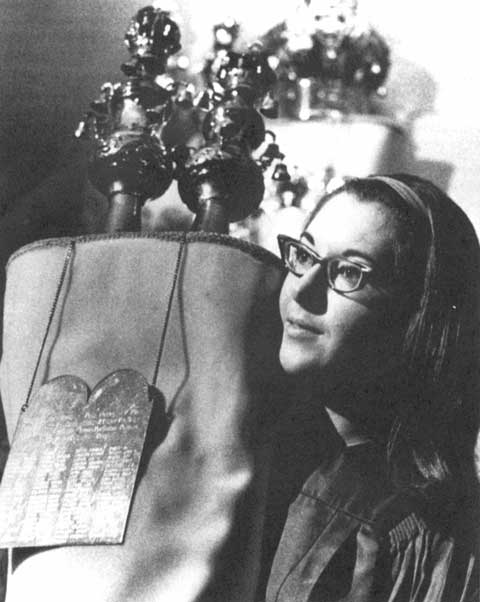
This June marks a momentous event in Jewish history.  On June 3, 1972, forty years ago, Rabbi Sally Priesand stood on the bima at Plum Street Temple in Cincinnati, Ohio, and was ordained as the first female rabbi.  On that same date 18 years ago, June 3, 1994, I stood on that same bima at Plum Street Temple and took my place in the line of  611 female Reform rabbis that have since followed in Rabbi Priesand’s path.

Rabbi Sally Priesand, 1972


Forty is a significant number in Jewish tradition.  When Noah built the ark, the rain lasted for 40 days and nights. The Jewish people wandered for 40 years in the wilderness before entering the land of Israel. Moses spent 40 days and nights up on Mt. Sinai to receive Torah. The spies that Moses sent out to explore the land were there for 40 days. One is only considered old and wise enough to study kabbalah, Jewish mysticism, at the age of 40.  A mikveh must be filled with 40 seahs of water. According to Rabbi Judah Loew, the Maharal of Prague(16th century), the number 40 has the ”power to transform one’s spiritual state. ” 40 is also considered a number of completion.  The number of days that it takes an embryo to form in its mother’s womb according to the Talmud is 40 days (Talmud Bavli Yevamot 69b).  While science today would disagree with that idea, we do know that gestation of a human being is 40 weeks. And  in the Mishnah (Shabbat 7:2) there is a list of 39 melachot or categories of labor or creative work that are forbidden on Shabbat, described as “40 less one”. These categories correspond to the 39 modes of constructive labor it took to build the Mishkan in the wilderness. And on Shabbat we rest from those labors, step out of this physical work, and make room for the spiritual fulfillment of Shabbat. Why 40 less one?  The sages teach that 40 is the number of completion, that these 39 categories of physical  labor it took to build the Mishkan were not complete without the spiritual labor to bring Shabbat into the Mishkan. These 39 categories of work parallel the work that went into the creation, with the one exception of the spiritual dimension of creation, and that is what completes the work, hence the 40th is the completion, the spiritual dimension.

While I would hesitate to say that we have arrived at a place of completion for women’s status in Jewish life, certainly, 40 years of women’s rabbinic leadership have powerfully transformed the Jewish world’s spiritual state.

As I write this message, Rabbi Miri Gold has just been recognized as the first non-orthodox rabbi of a congregation in Israel. This decision paves the way for other Reform and Conservative rabbis in Israel, both men and women, to receive government recognition and a salary, in the same way that over 4000 orthodox rabbis are recognized. Just a few weeks ago, Rabbi Alona Lisitsa became the first Israeli Reform Rabbi to sit on a municipal religious council nominated by the Minister of Courts (after an injuction by the Supreme Court). Two years ago, Rabba Sara Hurwitz became the first Orthodox female rabbi.

Forty years ago, who could have imagined orthodox women learning and teaching Talmud, or leading tefillah (prayer) in orthodox egalitarian minyanim.
But we still have along way to go before we get to the promised land where we can all stand at Sinai together. 40 years of work and journeying in the wilderness have led us as a Jewish family to a new place and a new spiritual state but we are still on a journey. As Judith Plaskow writes “We must expand the notion of Torah to encompass not just the five books of Moses and traditional Jewish learning, but women’s words, teachings, and actions hitherto unseen. To expand Torah, we must reconstruct Jewish history to include the history of women, and in doing so alter the shape of Jewish memory.” (Judith PlaskowStanding Again at Sinai, p. 28)

Rabbi Sally Priesand
Judaism has changed and continues to change because of the work and leadership of women rabbis. As we look forward to the next steps on the journey, we wish Rabbi Sally Priesand Mazal Tov and Todah Rabbah!  Yeshar Kochech!

(cross posted on  Kol Isha, the blog of the Women's Rabbinic Network)

Tuesday, April 3, 2012

Religious Freedom and Equality in Israel

What does freedom mean?  As Pesach approaches, we retell the story of our ancestors, and offer thanks to God that in this season we went forth from slavery to freedom.  The Haggadah reminds us that each of us must teach our children that “it is because of what God did for me, when I went out of Egypt”, in other words, each of us must view ourselves as having personally gone forth from Egypt. Freedom is defined as the absence of coercion or constraint imposed by another person or by the state.  A person is free to the extent that she can choose her own goals and course of life, can make choices between the alternatives available to her, and is not compelled to act in a manner that she would not choose; or is not prevented from acting as she would like.  In our world there is a practical connection between freedom and power. 

In Israel today there are many challenges posed by an imbalance of power that threatens the core values of Israeli society. Democracy and fairness are under attack because the ultra-Orthodox leadership insist that their Jewish vision is the only way. The power that the ultra-Orthodox religious authority currently holds, undermines the freedom for different religious expressions of Judaism to exist in Israel.  Israeli Reform, Masorti/Conservative, and secular Jews are uniting in support to strengthen pluralism in Israeli society and promote equal rights for different religious expressions of Judaism.

The Israel Religious Action Center is actively involved in challenging the ultra-Orthodox establishment, and is involved in more than 60 court cases each year.  

These cases include:
  • Choice in wedding ceremonies – recognition of non-Orthodox rabbis as officiants and civil marriage in Israel as an alternative to religious ceremonies.
  • Choice in burial procedures – implementing an already existing alternative burial law allowing for civil burial sections in all public cemeteries
  • Recognizing non-Orthodox conversions
  • Preventing discriminatory legislation against non-Orthodox practices
  • Equal treatment of all streams of Judaism – the employment of non-orthodox Rabbis in municipal settings, providing equitable funding of communal, educational and religious activities
  • Eliminating gender separation - on public buses and all public places and facilities
  • Core curriculum for all - schools receiving any State funding must teach the Ministry of Education core curriculum which prepares students to participate in the job market and a democratic, civil society
  • Reducing the authority of religious courts  – in family and life cycle matters
  • The right for women to pray together at the Wall – Women of the Wall seek to pray aloud as a group, wear tallit and read from the Torah 
  • Freedom of religion and conscience - as protected by the 1948 Declaration of Independence of the State of Israel.
Over the last several decades, the Reform and Masorti/Conservative movements have made progress. The outreach efforts of our congregations and education initiatives all over the country are bearing fruit. As more and more Reform congregations spring up and become established pillars of their communities, Israelis are starting to see that the Reform movement has a lot to offer them.  Anat Hoffman, head of the Israel Religious Action Center reports that “Many Israelis who oppose gender segregation, racist incitement by rabbis, or the Orthodox monopoly on marriage and divorce see that we are on the front lines pushing back against the ultra-Orthodox hegemony. They look at our work and think, "Here is a group that represents my Jewish values. If that is what it means to be Reform, then I'm Reform."”

As Rabbi Gilad Kariv, Executive Director of the Israel Movement for Progressive Judaism, recently said "it is striking that the political and legal reality in Israel regarding relations between religion and state lags far behind the true position of Israeli society. For sure, both movements still face significant challenges, but it is no longer possible to dismiss their activities in Israel or their impact on Israeli society. We believe that the development of both movements will eventually lead to a change in their political and legal status.”

Within the last month one of the major issues that non-Orthodox Israelis have been concerned with has made progress.  The Tal law, that exempts the ultra-Orthodox from military service has been struck down. According to this recent court decision, now all Israelis, including the ultra-Orthodox, must share the burden of full army or national service. 

In January, Shimon Peres became the first president of Israel to appear publicly with the Masorti (Conservative) movement, after 35 years since the movement’s founding in Israel. Peres attended a performance of Shirat Machar, the Masorti co-ed performance troupe, and opened his remarks by saying, “I came here this evening to hear women singing,” referring to the haredi soldiers who walked out of an IDF event where women soldiers were performing. He also praised the Masorti movement’s “commitment to humanism, peace, human rights and the rights of citizens,” saying that it is time to recognize the religious rights of all Jews in Israel. “Different streams exist in Judaism,” Peres said, “which has room for conservative and liberal viewpoints.” 

Yet there is more work to be done. In response to the work of IRAC, Ultra-Orthodox Member of the Knesset Eichler has publicly referred to IRAC staff and Rabbi Gilad Kariv  as "Reform anti-semites" and "Reform enemies of the state". Certainly change needs to happen at the grassroots level by Israeli voters  who can focus their efforts to ensure that members in the next Knesset will promote legislation to protect the democratic, Jewish and pluralistic nature of the State of Israel.  As American Jews and supporters and lovers of Israel, we can also work for change to ensure that Israel lives up to the Declaration of the Establishment of the State of Israel  which says: "[The State] will ensure complete equality of social and political rights to all its inhabitants irrespective of religion, race or sex". What is at stake is nothing less than the morality of Israel’s motives, and the integrity of her actions; the democratic, pluralistic future of the modern state of Israel. Anat Hoffman, Executive Director of the Israel Religious Action Center reports that the internal issues currently plaguing Israel - religious pluralism, minority rights, and gender equality are as great a threat to Israel's future as the prospect of a nuclear Iran.

What can you do? Get involved.  Become informed - read the Israeli press, follow what is going on through organizations like Hiddush: for religious freedom and equality in Israel. Let Israel know that you care.  Send messages of support to the Israel Movement for Progressive Judaism, our Israeli counterparts in the Reform movement. Send contributions to support the work of the Israel Religious Action Center and the Women of the Wall. Sign petitions to let the Israeli government know that Israel is a place for all Jews. And go Visit Israel.

Women of the Wall website: www.womenofthewall.org.il.

Monday, January 9, 2012

URJ Biennial 2011, Washington, DC


This December 14-18, 2011, I was among more than 5000 Jews who attended the Union for Reform Judaism Biennial in Washington DC. Delegates from over 500 congregations in North America, Israel, and the UK studied, prayed, debated resolutions, and celebrated Shabbat together in an atmosphere of learning, networking, and passion for the future of Reform Judaism.

A major highlight of the biennial was hearing from President Obama, who gave a stirring address to the assembly,  addressing issues of social justice and  Israel, and peppered with humor - referring to his daughter Malia's busy schedule attending friends' bat mitzvahs, and giving a shout out to NFTY, the North American Federation of Temple Youth. He began his remarks by wishing us an early Shabbat Shalom and then continued with a d'var Torah on the portion of the week, resonating with the word “Hineini”,  “Here I am”. It was an exciting and moving start to our Shabbat together. We were also privileged to hear from Ehud Barak, and Natan Sharansky, and had the opportunity to dialogue and discuss the challenges and opportunities for Reform Jews in Israel with representatives from Israeli Reform congregations.


This year's biennial marked a major leadership transition as Rabbi Rick Jacobs became the new President of the Union for Reform Judaism.  Rabbi Eric Yoffie, who is retiring after having led the movement for the last 16 years, was celebrated in prayer, speech, and song on Saturday evening at Havdalah. Rabbi Jacobs shared his passionate vision for the future of Reform Judaism at the closing plenary on Sunday morning.

This year's biennial also had the largest attendance of Jews in their 20s and 30s and inaugurated a new initiative for the URJ, the Campaign for Youth Engagement, or CYE.  This initiative is a strategic plan to develop greater youth involvement and reinvigorate our movement's strategies for retaining youth post b'nei mitzvah and through high school and making our congregations more welcoming and responsive to the needs of Jews in the post- college and young adult years through their 20s and 30s. The convention halls were full of people, ideas, and energy.  There was also a large exhibit hall of vendors for Judaica shopping, Jewish books and music, and programmatic resources.
Prayer Services at URJ Biennial 2011
I attended many different learning sessions from Yoga Shalom to the Changing Landscape of Jewish Life, Judaism and Technology in the Digital Age, What Jews Need to know about Genetic Diseases - (the importance of genetic testing and counseling for young Jews),  and New Trends in Jewish Religious Education,  and much more.  I reconnected with old friends,  colleagues,  and teachers,  and made new friends and connections.

Kumsitz with friends
I danced and sang at biennial Shabbat and daily worship, studied text with wonderful and insightful scholars, and was thrilled to hear many Jewish musicians perform - Josh Nelson, Dan Nichols, Julie Silver, Jeff Klepper,  Beth Schafer, Joe Black, Rick Recht,  Michelle Citrin,  Noah Aronson, Ellen Allard, Shira Kline, Peri Smilow, and many more.  We were all profoundly missing Debbie Friedman at this biennial. The conference included a beautifully moving and heartfelt tribute to Debbie and her music. As Josh Nelson said, “She was there at the beginning and she is still with us now through her songs.” Theodore Bikel received a special award from the URJ and Saturday evening we were privileged to hear the incomparable guitarist and Israeli singer David Broza.  Services were enhanced with beautiful music from a special biennial choir and a choir of the American Conference of Cantors.  After the evening programming and concerts ended there was an informal late night kumsitz with old and new friends. The one thing I did not do much of at the biennial was sleep!
Kol B'seder - Rabbi Dan Freelander and Cantor Jeff Klepper - URJBiennial 2011
David Broza at URJ Biennial 2011
You can view videos from this year's biennial of speakers, teachers, and Shabbat services and music at the URJ Biennial 2011 link and be inspired!  And then plan to attend the URJ Biennial 2013 Dec. 11-15 in San Diego!