Showing posts with label Israel. Show all posts

Tuesday, July 29, 2014

My Heart Is In the East

I am writing as I sit outside under the trees at Goldman Union Camp Institute (GUCI). Camp is a place that is in many ways sheltered from the rest of the world, it is a place of peace, where lifelong friendships are formed, and Jewish souls are nurtured. But this summer I as I sit under the trees, teach and learn, connect with colleagues and friends, sing songs and watch campers grow, I am deeply troubled.

Since arriving here, Israel has entered into a ground war in Gaza, to protect her citizens from the non-stop barrage of missile attacks from Hamas. Operation Protective Edge began just a few weeks before I came to camp, and in a short time it became clear that the Iron Dome system would not be enough to halt the attacks. Israel has agreed to multiple cease fires, Hamas refused to stop shooting. This forced Israel to consider sending troops into Gaza.  After completely withdrawing from Gaza in 2005, going back into Gaza for a ground operation was not a decision made lightly.  As Israel calls phones and drops leaflets to warn Gazans to take shelter, Hamas continues to urge its citizens to ignore the IDF’s warnings, to be human shields for the warfare, and continues to place armaments and rocket launchers in schools, hospitals, and mosques. The United Nations continues to condemn Israel for her actions, even as they admit to discovering rockets placed deliberately in school buildings, and then amazingly, handing over those same rockets to the Palestinian leadership.

Since entering Gaza, Israel has discovered 31 tunnels so far with more than 60 shafts leading to them.  These tunnels were built by Hamas using forced child labor.  More than 160 Palestinian children died constructing them. Israel us reporting that these tunnels are full of explosives, missiles and other weaponry. These tunnels were built as part of a long term large scale plan to launch a massive assault on Israeli civilians to take place just two months from now, on Rosh Hashanah. This surprise attack was planned to send 200 Hamas fighters through the tunnels under the border from Gaza into Israel, wearing Israeli army uniforms. Then the plan was to take control of kibbutzim and other communities while killing and kidnapping Israel civilians.

Antisemitic acts of violence and demonstrations are occurring with increasing frequency. These reports of violence and anti-Israel sentiment, which simply put is anti-Jewish sentiment, are frightening. There have been riots and anti-semitic mobs in Paris, Calgary, and Belfast and anti-Israel rioters and vandalism in Chicago, Connecticut and Boston.

Here at camp, on this past Shabbat, our Israeli counselors shared prayers for peace, and prayers for safety for their families and friends, and for those in the Israeli Defense Forces.  The Israeli counselors have shed more than a few tears and I can see worry on their faces, but for the most part, here at camp, we are immersed in providing all of the campers with a great environment for learning about themselves and their Jewish identity.

Our Israeli Shlichim Share Prayers for Peace
Friends and colleagues in Israel have been sharing their firsthand experiences, of traveling in Israel, running to bomb shelters, and going about their daily lives. I am proud of our NFTY (North American Federation of Temple Youth) staff and the URJ, who were able to continue touring with our teen groups on our Israel trips this summer and keeping them safe. I am proud of my CCAR rabbinic colleagues flew to Israel on a quickly arranged mission of support. They are taking shelter in stairwells and bomb shelters as they visit the border towns adjacent to Gaza, and deliver care packages of toiletries, energy bars, and other items for lone soldiers. Aliyah flights to Israel have continued, and despite arriving in a war zone, not one family backed out of their plans to make aliyah.

It is a very troubling time. Many of us feel powerless to be able to do anything. Some of us feel conflicted about what is happening in Israel and what is happening in Gaza. It is certainly disturbing that so many children on both sides of the conflict are again living with fear. And there are people suffering.  If you want to do something, below are some ways to support Israel and those who are living with daily missile attacks:

Israel Movement for Progressive Judaism (Reform Judaism in Israel - IMPJ) through the World Union for Progressive Judaism (WUPJ), 633 Third Ave. 7th floor NYC 10017. The WUPJ and IMPJ are doing great work to assist those impacted and to keep lines of communication open between Israelis and Arab communities in Israel.


Friends of the IDF - Friends of the IDF is in Israel supplying the IDF soldiers on the frontlines with snack packages, toiletry kits, and underwear.  


Silence the Sirens -  The URJ and Jewish Federations of North America are collecting funds to provide emergency aid and alleviate the pain and suffering of our Israeli brothers and sisters.


Yad Eliezer has distributed food and supplies to residents of Southern Israel living under a constant barrage of rockets with food and treats for families stuck at home in bomb shelters.

The Jaffa Institute, which looks after children across South Tel Aviv and Jaffa, have relocated 170 at-risk children from communities hit hardest from rockets - donations go to recreational activities, learning materials, food and treatment.


Natal is an organization that provides hotlines for people who are suffering anxiety and need to speak with someone - both for people in the North and the whole of Israel.

Sunday, March 2, 2014

Like Dreamers

So much has been written about the history of modern Israel, a place we love, and whose politics we also sometimes struggle to understand.  I recently finished reading Yossi Klein Halevi’s new book, "Like Dreamers: The Story of the Israeli Paratroopers Who Reunited Jerusalem and Divided a Nation”.  “Like Dreamers” tells the story of modern Israel through the personal stories of seven men who served as paratroopers in the elite 55th brigade, who were part of the miraculous victory of the war of 1967 and the recapturing of the Old City of Jerusalem.

Yossi Klein Halevi spent the past 10 years following the lives of the paratroopers who liberated the Kotel in 1967.  Not long after making aliyah in 1982, he decided that he wanted to write a book interviewing veterans of the battle of Jerusalem.  “How had the war changed their lives? What role did they play in trying to influence the political outcome of their military victory?"  Through ten years of research and developing relationships with seven of these men, each of whom took distinct paths.  As he follows their stories, Halevi tells the story of Israel through their eyes and gives us a greater understanding of the political dilemmas, different ideologies, and myriad personalities that have shaped Israel today.

1967 paratroopers with 2013 Women of the Wall (Anat Hoffman - chairwoman (right) and Lesley Sachs - executive director (left))
The characters in the book are not characters, they are real people with real lives and real dilemmas and that is what can give us a greater understanding of many of the internal debates that are a very real part of life in Israel today. Of the seven paratroopers profiled, some became religious settlers, others secular kibbutzniks, musicians and artists. They had careers in high tech, and politics, and industry. Some became active on the left, others on the right. And in this small country, being part of the same small elite brigade connected them together for life in spite of their differences. Their stories serve as a metaphor for the challenges both internal and external that Israel faces today.
David Rubinger’s famous photo of the IDF paratroopers at the Western Wall in 1967
When I was in Israel in November for the  Women of the Wall 25th anniversary solidarity mission, I was overcome with emotion at the Wall, in being there together with so many women from so many disparate Jewish backgrounds, yet bound together by a single purpose.  After reading "Like Dreamers", I now look at the iconic photograph of the young soldiers standing at the wall in a different way. The young men of the 55th brigade, like all Israelis in 1967, had dreams and visions and hopes. Yet they too came from disparate backgrounds and went on to live different lives all in the same small country, all struggling with the same questions of Israel’s survival, and a quest for “normalcy” within what Halevi describes as "the agonizing complexity of Israel's dilemmas."

Wednesday, November 13, 2013

Reflections on the 25th Anniversary of Women of the Wall Rabbinic Mission

We woke early, at 5:30am and grabbed a quick breakfast on our way to the Old City of Jerusalem. We made our way through the narrow, winding streets until we arrived at the security entrance to get to the Kotel, the Western Wall.  Standing in line as I waited to pass through security, I looked up at the sign that read: “Dear Visitor, You are approaching the holy site of the Western Wall where the Divine Presence always rests. Please make sure you are appropriately and modestly dressed so as not to cause harm to this holy place or to the feelings of the worshippers. Sincerely, Rabbi of the Western Wall and Holy Sites.” In my small bag rested my tallit, and camera. As I put my bag on the conveyor belt, my kippah already on my head, I thought back to the last time I had been to the Kotel for Rosh Chodesh, in the summer of 2010.  A summer in which Anat Hoffman, leader of Nashot Hakotel, Women of the Wall, had been arrested for carrying the Torah scroll, and was then prohibited from coming near to the Kotel for 30 days, “so as not to cause harm to this holy place or to the feelings of the worshippers”.
As I entered the Kotel plaza, the gathering area in the back, which was relatively quiet and empty in the early morning, I thought back to my first visit to the Kotel plaza, on a summer college trip, and of the service we held there, praying together as a mixed group, singing our prayers aloud. I thought about the family trip I had been on with my home congregation, where as a group we made havdalah at the end of Shabbat and sang aloud together Debbie Friedman’s setting of the havdalah blessings. And I thought of the many IDF soldiers who have been commissioned at this same spot, where no longer are mixed groups able to gather for prayer, and where women’s voices have been silenced during public ceremonies such as the IDF commissioning, “so as not to cause harm to this holy place or to the feelings of the worshippers.”

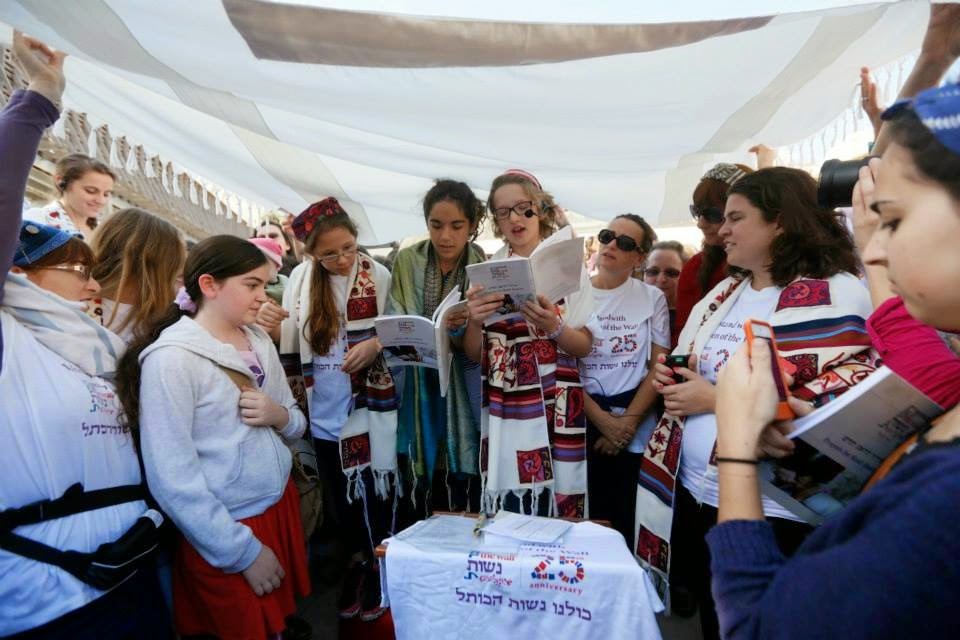
I thought about the 25 years that each month the Women of the Wall have come on Rosh Hodesh, in small groups and large, in rain or heat, in prayer and persistence, to lift their hearts and voices together in prayer out loud, wearing tallit and tefillin. I thought about the Israeli paratroopers who stood at the Wall in 1967 with tears streaming down their faces and of those same soldiers who stood again at the Wall with Anat Hoffman last February, and of the 10 women who were arrested after the paratroopers and the press left, “so as not to cause harm to this holy place or to the feelings of the worshippers.”
I looked at the beautiful sunlight glinting on the light colored Jerusalem stone, and I took my place to secure the perimeter edge for the group of my sisters, my mothers, my grandmothers, my daughters, my friends who were coming to raise their voices out loud to celebrate Rosh Hodesh Kislev, the month of dreams, and I prayed
זֶה-הַיּוֹם, עָשָׂה יְהוָה;  נָגִילָה וְנִשְׂמְחָה בוֹ
Zeh Hayom Asah Adonai Nagilah v'nis'mecha vo
This is the Day that God has made, let us rejoice and be glad in it. (Psalm 118:24)


And I rejoiced. With more than 800 Jewish women who gathered from all over Israel and across the world, and over 200 male supporters who stood behind the mechitza and the barrier, I rejoiced. I rejoiced with Orthodox and Reform and Conservative and Reconstructionist and Renewal and Just Jews, I rejoiced.  I rejoiced with the young girls who were under a tallit chuppah to chant the blessings for the Rosh Hodesh Torah reading. I rejoiced with the Israeli policewomen who came not to harass us this time, not to tell us to shhh be quiet or to wrap our tallitot like scarves, but this time to ring our group with their bodies to protect us from harassment and from things thrown at us, from spitting and yelling and whistles.


And I thought, surely the Shechina, the Divine Presence who always rests here, rejoices that I am here in the holy place with my tallit, surely the Shechina wants to hear the voices of all Jews raised in prayer in song , surely the Shechina understands that our prayers cannot cause harm to this holy place or to the feelings of the worshippers.

Tuesday, April 3, 2012

Religious Freedom and Equality in Israel

What does freedom mean?  As Pesach approaches, we retell the story of our ancestors, and offer thanks to God that in this season we went forth from slavery to freedom.  The Haggadah reminds us that each of us must teach our children that “it is because of what God did for me, when I went out of Egypt”, in other words, each of us must view ourselves as having personally gone forth from Egypt. Freedom is defined as the absence of coercion or constraint imposed by another person or by the state.  A person is free to the extent that she can choose her own goals and course of life, can make choices between the alternatives available to her, and is not compelled to act in a manner that she would not choose; or is not prevented from acting as she would like.  In our world there is a practical connection between freedom and power. 

In Israel today there are many challenges posed by an imbalance of power that threatens the core values of Israeli society. Democracy and fairness are under attack because the ultra-Orthodox leadership insist that their Jewish vision is the only way. The power that the ultra-Orthodox religious authority currently holds, undermines the freedom for different religious expressions of Judaism to exist in Israel.  Israeli Reform, Masorti/Conservative, and secular Jews are uniting in support to strengthen pluralism in Israeli society and promote equal rights for different religious expressions of Judaism.

The Israel Religious Action Center is actively involved in challenging the ultra-Orthodox establishment, and is involved in more than 60 court cases each year.  

These cases include:
  • Choice in wedding ceremonies – recognition of non-Orthodox rabbis as officiants and civil marriage in Israel as an alternative to religious ceremonies.
  • Choice in burial procedures – implementing an already existing alternative burial law allowing for civil burial sections in all public cemeteries
  • Recognizing non-Orthodox conversions
  • Preventing discriminatory legislation against non-Orthodox practices
  • Equal treatment of all streams of Judaism – the employment of non-orthodox Rabbis in municipal settings, providing equitable funding of communal, educational and religious activities
  • Eliminating gender separation - on public buses and all public places and facilities
  • Core curriculum for all - schools receiving any State funding must teach the Ministry of Education core curriculum which prepares students to participate in the job market and a democratic, civil society
  • Reducing the authority of religious courts  – in family and life cycle matters
  • The right for women to pray together at the Wall – Women of the Wall seek to pray aloud as a group, wear tallit and read from the Torah 
  • Freedom of religion and conscience - as protected by the 1948 Declaration of Independence of the State of Israel.
Over the last several decades, the Reform and Masorti/Conservative movements have made progress. The outreach efforts of our congregations and education initiatives all over the country are bearing fruit. As more and more Reform congregations spring up and become established pillars of their communities, Israelis are starting to see that the Reform movement has a lot to offer them.  Anat Hoffman, head of the Israel Religious Action Center reports that “Many Israelis who oppose gender segregation, racist incitement by rabbis, or the Orthodox monopoly on marriage and divorce see that we are on the front lines pushing back against the ultra-Orthodox hegemony. They look at our work and think, "Here is a group that represents my Jewish values. If that is what it means to be Reform, then I'm Reform."”

As Rabbi Gilad Kariv, Executive Director of the Israel Movement for Progressive Judaism, recently said "it is striking that the political and legal reality in Israel regarding relations between religion and state lags far behind the true position of Israeli society. For sure, both movements still face significant challenges, but it is no longer possible to dismiss their activities in Israel or their impact on Israeli society. We believe that the development of both movements will eventually lead to a change in their political and legal status.”

Within the last month one of the major issues that non-Orthodox Israelis have been concerned with has made progress.  The Tal law, that exempts the ultra-Orthodox from military service has been struck down. According to this recent court decision, now all Israelis, including the ultra-Orthodox, must share the burden of full army or national service. 

In January, Shimon Peres became the first president of Israel to appear publicly with the Masorti (Conservative) movement, after 35 years since the movement’s founding in Israel. Peres attended a performance of Shirat Machar, the Masorti co-ed performance troupe, and opened his remarks by saying, “I came here this evening to hear women singing,” referring to the haredi soldiers who walked out of an IDF event where women soldiers were performing. He also praised the Masorti movement’s “commitment to humanism, peace, human rights and the rights of citizens,” saying that it is time to recognize the religious rights of all Jews in Israel. “Different streams exist in Judaism,” Peres said, “which has room for conservative and liberal viewpoints.” 

Yet there is more work to be done. In response to the work of IRAC, Ultra-Orthodox Member of the Knesset Eichler has publicly referred to IRAC staff and Rabbi Gilad Kariv  as "Reform anti-semites" and "Reform enemies of the state". Certainly change needs to happen at the grassroots level by Israeli voters  who can focus their efforts to ensure that members in the next Knesset will promote legislation to protect the democratic, Jewish and pluralistic nature of the State of Israel.  As American Jews and supporters and lovers of Israel, we can also work for change to ensure that Israel lives up to the Declaration of the Establishment of the State of Israel  which says: "[The State] will ensure complete equality of social and political rights to all its inhabitants irrespective of religion, race or sex". What is at stake is nothing less than the morality of Israel’s motives, and the integrity of her actions; the democratic, pluralistic future of the modern state of Israel. Anat Hoffman, Executive Director of the Israel Religious Action Center reports that the internal issues currently plaguing Israel - religious pluralism, minority rights, and gender equality are as great a threat to Israel's future as the prospect of a nuclear Iran.

What can you do? Get involved.  Become informed - read the Israeli press, follow what is going on through organizations like Hiddush: for religious freedom and equality in Israel. Let Israel know that you care.  Send messages of support to the Israel Movement for Progressive Judaism, our Israeli counterparts in the Reform movement. Send contributions to support the work of the Israel Religious Action Center and the Women of the Wall. Sign petitions to let the Israeli government know that Israel is a place for all Jews. And go Visit Israel.

Women of the Wall website: www.womenofthewall.org.il.

Wednesday, August 10, 2011

Av to Elul - The Soul's Journey

The rhythm of Jewish time seems to run a bit slower in the summer months, as the sun shines high in the sky, the heat lingers and the days last longer.   Traditionally the Jewish months of Sivan, Tammuz, Av and Elul are bookends to this hot period of time.  Sivan ushers in summer with the holiday of Shavuot, the giving of the Torah at Mt. Sinai, and Elul is introspective as we prepare for Rosh Hashanah and Yom Kippur.  Within Tammuz and Av are days of mourning that reflect sad times within Jewish history – the fast of the 17th of Tammuz which marks the breaching of the Temple walls which culminated in the destruction of the Temple in Jerusalem on the 9th of Av.   Between these dates is the period of three weeks known as Bein Hametzarim, literally “in a narrow place”.  It is not hard to imagine the kind of narrow straits our people must have felt in the dry heat of summer in Jerusalem as they witnessed the destruction.  On Tisha B’Av Jews fast, sit on the floor, and weep as we chant the beautiful and mournful words of Lamentations.  In ancient times the Jewish people believed that the holy Temple was the meeting place between us and God.  Though we believe that the Divine presence is everywhere, this was the place of great intimacy between people and God.  Several times each year Jews would journey to the Temple in Jerusalem and perform rituals and seek to come closer to the Divine presence in the world. 
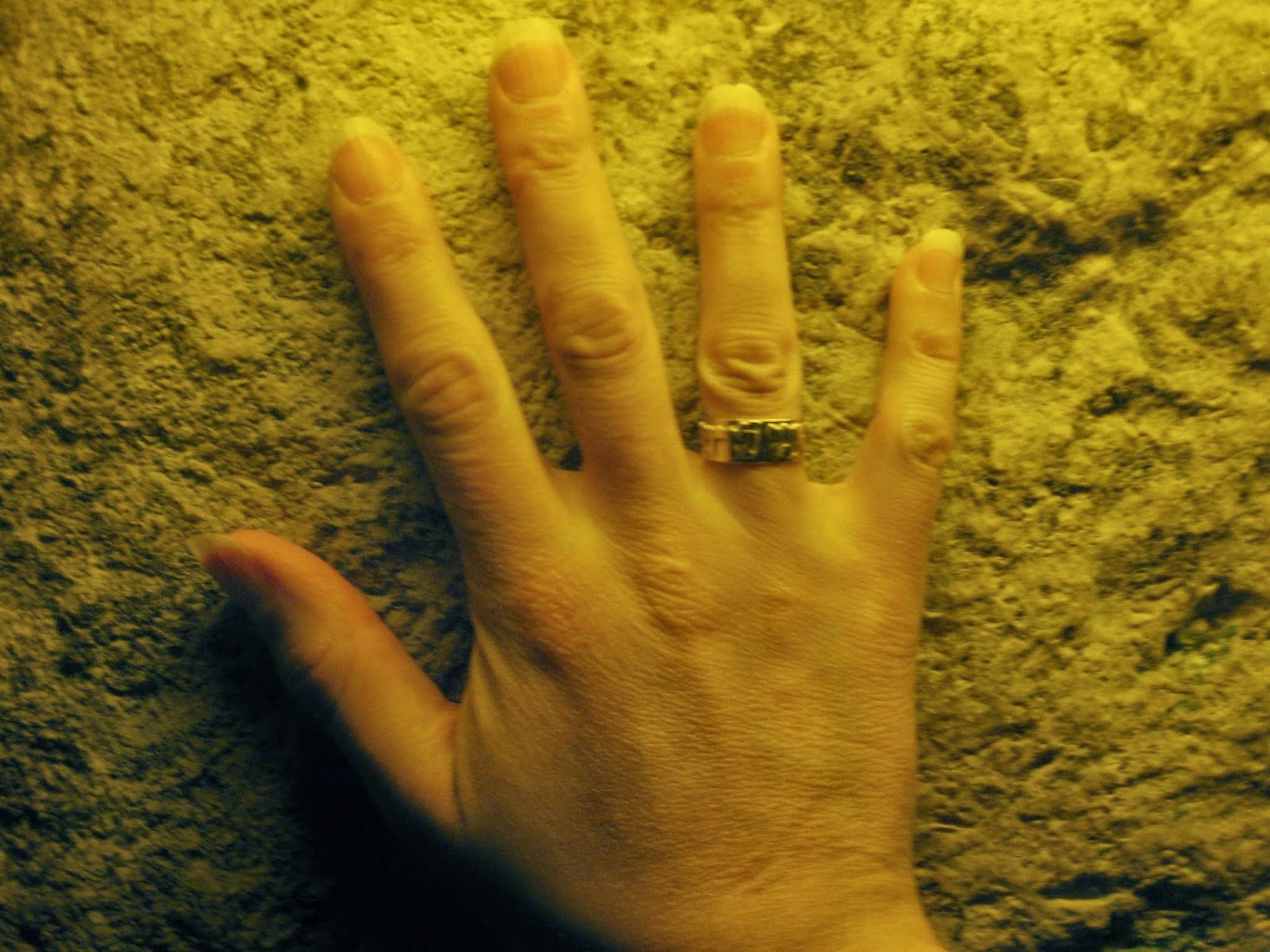
What do these days mean for us today? For us today, this may seem distant and ancient history.  Many liberal Jews are not familiar with the fast of Tammuz or the observance of Tisha B’Av. And yet, there is something powerful that connects us to these stories and this place.  Last summer in Jerusalem I went to the Kotel, the Western Wall many times.  I had the opportunity to tour underneath the Wall in the tunnels and place my hand on the ancient stones close to where the Holy of Holies had been, where for thousands of years Jews had placed their hands on the ancient stones, and cried, and rejoiced and prayed.  There is something about being in a sacred space that opens us to the spiritual, that shuts out the noisiness of life and allows us to hear and be at one with the universe.
A Hasidic tale about the “Seer of Lublin”, Rabbi Yitzchak Yaakov Horowitz, explains the power of place and time that changes us, that enables us to be more in harmony with God:
 
As a young child the rabbi lived near a forest. Almost every day he would venture off in to the woods by himself.  His father did not want to interfere with his son’s explorations but he worried about robbers and animals that could be lurking in the forest that could harm his son.  One day his father pulled the boy aside and said “I know that you go to the forest every day. I am concerned for your safety.  What is it that draws you there and what do you do there? 

The young boy responded simply:  “I go there to find God.” 

His father thought for a moment and then responded: “That’s beautiful, but don’t you know that God is the same everywhere?” 

“God is”, responded the boy, “but I’m not.”

As the summer wanes and we enter Elul, our soul’s journey calls us to awaken and reflect on the year that has passed and the one that is yet to be. As we embark on the journey from Av to Elul may we seek the place that connects us, that changes us, and that enables us to take the next steps along our sacred path.

Friday, January 7, 2011

Tu B’shevat and the Carmel Forest Fire

During our sabbatical in Israel this past summer, my family and I were fortunate to enjoy hiking in Israel’s nature preserves and forests, and swimming in natural pools and waterfalls.  But Israel is in the midst of a severe drought and this year during Chanukah,  the festival of lights, Israel faced a severe crisis.  A massive wildfire burned over 12,500 acres, over 5 million trees, in the Carmel Forest near Haifa.   The fire claimed 42 lives and displaced more than 17,000 people from their homes.  As the winds intensified, the flames spread across the dry forest and raged through the Carmel Hai-Bar Nature Reserve, the UNESCO BioReserve on the Carmel Mountain Range and Kibbutz Beit Oren, decimating wildlife, unique forestry and  plants, and homes, including those of Israeli Jews, Israeli Arabs, and Druze.

Over many years Israel  has reached out to assist many countries during devastating disasters.  They have sent humanitarian aid to help after the earthquakes in Turkey, Haiti, Chile and El Salvador, sent personnel and food to help with starvation in Ethiopia and responded to Hurricane Katrina and the tsunami in 2004. And we are grateful that the world responded to help Israel this time of need: the Palestinian Authority sent trucks and crews that drove for hours to help with the raging fires.  Turkey put aside the diplomatic challenges of the past year and sent fire fighting planes in formation with Greece to stop the fire.  The US, Bulgaria, and Azerbaijan all sent aid to help Israel. Russia, France, Britain, Switzerland, and Germany sent planes and helicopters. Dozens of nations sent help and expressions of support. As Danny Ayalon, Israel’s deputy foreign minister said: “It is an incredible and much needed response and is proof that Israel can count on its friends during a time of national tragedy. To these, and the many other nations that offered assistance and aid, we send our most heartfelt appreciation.”

During this month of January, we will celebrate Tu B’shevat, the New Year of the Trees.  Many of us remember the blue boxes for JNF, and bringing home a certificate from religious school for planting a tree in Israel in honor of a significant occasion – a birthday, or a bar mitzvah, or in memory of a loved one.  This year it is even more important to plant trees in Israel to aid in the recovery from this tragic ecological and humanitarian disaster.  The Jewish National Fund is committed to forestry development and soil conservation, fire prevention, and innovative solutions to alleviate the water crisis in Israel. You can help Israel by donating funds to plant trees or order water certificates, and help JNF purchase fire trucks and protective gear, and provide for firefighter training.  

ARZA, the American Reform Zionist Association, is also accepting donations to help rebuild the affected areas.  Keren B’Kavod, ARZA’s humanitarian aid project, provided hot meals, food and supplies for the firefighters, and assisted people evacuated  due to the fire. Rabbi Gaby Dagan, rabbi of Reform congregation Ohel Avraham and the Leo Baeck education center in Haifa wrote:

“On Saturday morning, a Bar Mitzva ceremony was held in Ohel Avraham synagogue. A few minutes before the ceremony began, one of the guests told me that Elad Riven, a young school student from Haifa and a friend of the family, had died in the fire. It was not clear to the family that the ceremony should go ahead in such circumstances.

Once again, we must cross familiar and unfamiliar boundaries of joy marred by profound sadness. We said the “Shehechiyanu” prayer for the young boy who had just become a man, and with the same breath and the same tears we said Kaddish for those who will celebrate no more. The Bar Mitzva boy’s speech was transformed from the usual blend of optimism and naivety to the burning reality we faced. We celebrated, and we wept.

On Saturday afternoon and Sunday morning, students from Leo Baeck Education Center packed hundreds of food parcels for the firemen and for the families of school students from Usafiya, Daliyat al-Carmel, the Carmel Coast region, and the Dania neighborhood of Haifa. The showers at the community center were opened up to the security forces, offering a brief chance for them to relax and clean themselves. At such times, our lives are guided by the needs of families who have experienced and are still experiencing loss.”

ARZA is collecting donations towards helping the communities in the North rebuild.  You can donate online toward Keren B’Kavod and the fire relief programs in the North.