Showing posts with label miracles. Show all posts

Wednesday, November 13, 2013

Reflections on the 25th Anniversary of Women of the Wall Rabbinic Mission

We woke early, at 5:30am and grabbed a quick breakfast on our way to the Old City of Jerusalem. We made our way through the narrow, winding streets until we arrived at the security entrance to get to the Kotel, the Western Wall.  Standing in line as I waited to pass through security, I looked up at the sign that read: “Dear Visitor, You are approaching the holy site of the Western Wall where the Divine Presence always rests. Please make sure you are appropriately and modestly dressed so as not to cause harm to this holy place or to the feelings of the worshippers. Sincerely, Rabbi of the Western Wall and Holy Sites.” In my small bag rested my tallit, and camera. As I put my bag on the conveyor belt, my kippah already on my head, I thought back to the last time I had been to the Kotel for Rosh Chodesh, in the summer of 2010.  A summer in which Anat Hoffman, leader of Nashot Hakotel, Women of the Wall, had been arrested for carrying the Torah scroll, and was then prohibited from coming near to the Kotel for 30 days, “so as not to cause harm to this holy place or to the feelings of the worshippers”.
As I entered the Kotel plaza, the gathering area in the back, which was relatively quiet and empty in the early morning, I thought back to my first visit to the Kotel plaza, on a summer college trip, and of the service we held there, praying together as a mixed group, singing our prayers aloud. I thought about the family trip I had been on with my home congregation, where as a group we made havdalah at the end of Shabbat and sang aloud together Debbie Friedman’s setting of the havdalah blessings. And I thought of the many IDF soldiers who have been commissioned at this same spot, where no longer are mixed groups able to gather for prayer, and where women’s voices have been silenced during public ceremonies such as the IDF commissioning, “so as not to cause harm to this holy place or to the feelings of the worshippers.”

I thought about the 25 years that each month the Women of the Wall have come on Rosh Hodesh, in small groups and large, in rain or heat, in prayer and persistence, to lift their hearts and voices together in prayer out loud, wearing tallit and tefillin. I thought about the Israeli paratroopers who stood at the Wall in 1967 with tears streaming down their faces and of those same soldiers who stood again at the Wall with Anat Hoffman last February, and of the 10 women who were arrested after the paratroopers and the press left, “so as not to cause harm to this holy place or to the feelings of the worshippers.”
I looked at the beautiful sunlight glinting on the light colored Jerusalem stone, and I took my place to secure the perimeter edge for the group of my sisters, my mothers, my grandmothers, my daughters, my friends who were coming to raise their voices out loud to celebrate Rosh Hodesh Kislev, the month of dreams, and I prayed
זֶה-הַיּוֹם, עָשָׂה יְהוָה;  נָגִילָה וְנִשְׂמְחָה בוֹ
Zeh Hayom Asah Adonai Nagilah v'nis'mecha vo
This is the Day that God has made, let us rejoice and be glad in it. (Psalm 118:24)


And I rejoiced. With more than 800 Jewish women who gathered from all over Israel and across the world, and over 200 male supporters who stood behind the mechitza and the barrier, I rejoiced. I rejoiced with Orthodox and Reform and Conservative and Reconstructionist and Renewal and Just Jews, I rejoiced.  I rejoiced with the young girls who were under a tallit chuppah to chant the blessings for the Rosh Hodesh Torah reading. I rejoiced with the Israeli policewomen who came not to harass us this time, not to tell us to shhh be quiet or to wrap our tallitot like scarves, but this time to ring our group with their bodies to protect us from harassment and from things thrown at us, from spitting and yelling and whistles.
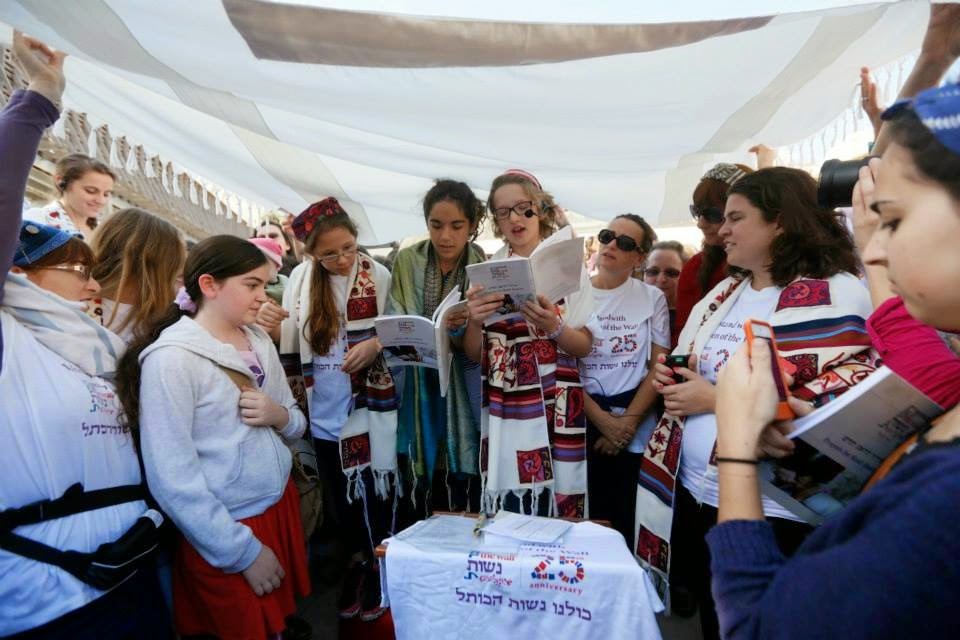

And I thought, surely the Shechina, the Divine Presence who always rests here, rejoices that I am here in the holy place with my tallit, surely the Shechina wants to hear the voices of all Jews raised in prayer in song , surely the Shechina understands that our prayers cannot cause harm to this holy place or to the feelings of the worshippers.

Friday, March 1, 2013

The Pesach Project - Passover in the FSU

40 years ago, in 1974, 26 year old Soviet Jewish dissident Natan Sharansky attended his first seder. For Sharansky, it was not difficult to identify with the Pesach story of freedom told in the Haggadah.  As a dissident, his life was made difficult and KGB agents waited around every corner. Some years later Sharansky led his own seder for the first time, but without the benefit of a Haggadah to read, or any of the elements of the seder to enjoy – no karpas, no matzah, no maror. Sharansky was alone in his prison cell but he did recount the story of Pesach to the prisoners next door through the small window of his cell.

For the community of dissidents in the Soviet Union of the 1970s no symbols were needed to remind them of the power that freedom has to transform society. The compelling story of the Exodus from Egypt, a nation of slaves rising up to defeat the most powerful Pharoah and his army, and lead the people forward to be a free people in their own nation was not ancient history, it was a symbol of of their cause. They understood the bitter tears of slavery that the Jewish people shed while in Egypt. For Sharansky and his fellow prisoners, their lives were a prayer and hope that the yoke of oppression would soon be broken and they would be able to sit reclining at the seder table and taste the flavor of freedom in years to come.  In 1986 Sharansky was finally released from Soviet imprisonment and he made aliyah to Israel. He is now the chairman of the Jewish Agency for Israel, the organization in charge of immigration and absorption of Jews from the diaspora into Israel.

As we sit at our seder tables this year, it may seem that 40 years is a short time, a blip in history. Yet our people wandered forty years in the desert on the way to the Promised Land.  And our work is not yet done.

Today in the former Soviet Union it is now possible to both learn about and practice Judaism: The Reform movement (known as the World Union for Progressive Judaism  -WUPJ) in the FSU has an active and vital presence: “After over 70 years of Communism, religious oppression and persecution, Jewish communities in the FSU have once again become vibrant with the World Union's assistance."

 
 The first congregation to officially join the Reform movement was Hineini in Moscow in 1990. Today, over 60 congregations in Russia, Ukraine, Belarus and the Baltic states, spanning 11 time zones from the Polish border to the Pacific Ocean, have officially become part of the World Union family, which now has offices in Moscow, St. Petersburg, Kiev and Minsk. There are currently six native-born rabbis and a full-time academic program, Machon, (the Institute for Modern Jewish Studies), to locate and train local paraprofessional community workers.

The Progressive movement operates nursery schools and Sunday schools all over the FSU under the leadership of a team of full-time education directors. Netzer Olami, the international Zionist youth movement of the World Union for Progressive Judaism, has become the largest Jewish youth movement in the FSU, operating summer and winter camps for some 1,000 participants, as well as youth clubs and counselor training programs.          

This Pesach, our former WELFTY advisor, Chase Foster, now a 1st year rabbinic student at Hebrew Union College (HUC) in Jerusalem will be participating this year in the Pesach Project, an annual program through HUC and the World Union for Progressive Judaism. He will be traveling along with 20 classmates to Berlin and then to various cities in the FSU - Gomel, Minsk and Lida, Belarus to assist small Jewish communities that do not have the resources to provide for Jewish professionals. Last year’s FSU trip allowed approximately 5,500 people to join around the seder table with community for Passover.  Chase has committed to fundraising $2500 for the Pesach project to help Jews in the FSU celebrate Pesach.  

At this season of freedom, may our love for the Jewish people and our support for outreach and education make this Passover a time of re-commitment to our people and our faith.

Wednesday, August 8, 2012

Everyday Blessings

Barukh Atah Adonai Eloheinu Melech Ha-olam, Shekachah Lo B’olamo
Praised are You, Adonai our God, Sovereign of the Universe, who has such beauty in the world.

As summer has passed by all too quickly, I have delighted in watching my three children enjoying the outdoors and the world around them.
All too often I find myself caught up in the busyness of life and forget to notice and be thankful for the many blessings that surround me.  One of the reasons I am grateful for my family is that they remind me to appreciate the many small gifts that are a part of every day.

Jewish tradition teaches us to utter brachot (blessings) throughout the day, and in so doing to live at a deeper level of awareness of experiences that we might otherwise miss.  In reciting a bracha (blessing), we invite in or recognize God’s presence in our midst. Blessings can be said in any language, and express a kavannah, an intention from one’s heart.

According to the great medieval Jewish philosopher, the RaMBaM – Moses Maimonides, there are three types of blessings:

Birchot HaNehenin – Blessings that we recite before eating, drinking, or smelling nice things.
Birchot HaMitzvot – Blessing that we recite prior to performing a commandment.
Birchot Hodaah – Blessings that express praise of God and give our thanks to God, or ask God for things.

There are traditional blessings for many of these experiences of life; you can find these in the siddur.  It is also appropriate to create your own blessing. Begin with the traditional formula: “Barukh Atah Adonai Eloheinu Melech Ha-olam Praised are You, Adonai our God, Sovereign of the Universe” and then continue with whatever you want to say – about your life, your health, how you are feeling, something good or bad that has happened, the world, your spouse, your children….

Reciting blessings open us to the potential for holiness in the world, and remind us that everything is interconnected, linking us to the oneness of God.

(cross posted at Kol Isha, the blog of the Women's Rabbinic Network

Wednesday, May 9, 2012

Happy Shavuot

For more than a century, the Reform movement has marked the anniversary of the giving of Torah at Mt. Sinai with the ceremony of Confirmation. Each year we look forward to celebrating with our young people as they mark their Confirmation of Judaism as young adults. We celebrate their learning as we usher in the holiday of Shavuot, the Feast of Weeks and the receiving of Torah at Mt. Sinai. 
I am convinced that the festival of Shavuot is the least remembered or observed of holidays among the big three (that is the three festivals that in the time of the Temple Jews went up to Jerusalem to observe – Sukkot and Pesach being the other two).  Since religious school is usually over by the time the holiday rolls around, few of us had terribly strong memories of Shavuot ritual.  For many, Confirmation is the only ritual surrounding Shavuot that sticks in our minds.  Yet, the holiday includes wonderful potential -- after all it does celebrate this most mysterious and momentous event: the giving of Torah at Sinai

But Shavuot is not only for young people; all of us stood at Sinai.  Shavuot is a celebration of Revelation, of the Giving of the Torah to the Jewish people on Mt. Sinai. In recognition of this Revelation, we read the portion of the Torah that the Torah itself says took place on Sinai  the story of the giving of the Ten Words, otherwise known as the Ten Commandments.

These Ten Commandments are not the only commandments of Judaism. Our tradition tells us that there are 613 mitzvot (the word means "commandments," not "good deeds"), all of which are important. But somehow, the Ten Commandments remain for us among the most basic of all laws. They are laws which form the foundation of the life of society: laws against idolatry, about family, about resting, and about basic morality. And these Ten Commandments remain important in our lives today.

Shavuot is also one of the special festivals in the year that has one of the five "scrolls" or megillot assigned to it.  On Shavuot, the scroll that we read is the Book of Ruth.  There are three reasons that the Book of Ruth is read on Shavuot. First, the story of Ruth takes place during the summer harvest.  Second, the story of Ruth reminds us that the Torah, which we received at Sinai, is so precious and valuable.  Ruth, a Moabite, chooses Judaism.  She elects to cast her lot with the Jewish people, saying: "Where you go, I will go, where you lodge I will lodge.  Your people shall be my people, and your God shall be my God."  Ruth's choosing Judaism makes us more aware and appreciative of the blessings of being Jewish.  Third, some scholars say that we read the Book of Ruth because it reminds us of King David.  King David was Ruth's great-grandson and traditionally Shavuot marks both David's birth and death. 

It is customary to stay up the entire night (leil) of Shavuot studying Torah with the community as we symbolically prepare to enter into a sacred relationship with God.  Many contemporary Jews choose to intensify and personalize the experience of revelation through studying Torah, talmudic, mystical and modern text and adding our own experiences and interpretations.

So, join us for Shavuot and the Confirmation service this year, and take some time to appreciate the gift of Torah in your life today as we stand together at Sinai.

Mazal Tov to our Confirmands and Happy Shavuot to All!

Thursday, March 1, 2012

Be Happy - It's Adar!

“When Adar arrives, our joy increases.” So we are told in the Talmud. So much of our lives is given over to serious matters, that when given the chance to rejoice and celebrate, and most of all to be silly, we really should not miss the opportunity.  That’s the case with the month of Adar, for Adar marks the festival of Purim in the Jewish calendar. 

All too often, we relegate Purim to the children in our community. But it’s not just for kids.  I’ve been to some quite wonderful adult Purim celebrations.  We’re never too old to dress up and enjoy this holiday.  After all, the themes, the characters and the story of Purim have much to add to our lives.  Purim is a joyous affirmation of Jewish survival despite the great odds that confronted Esther and her Uncle Mordecai.  The story of Purim is a story of people taking charge of their own destiny and it reminds us that celebration is essential in our sometimes difficult and complex lives.  We are given the opportunity to transcend, at least temporarily, the seriousness and busyness of everyday existence and are magically transported to a world of drama, revelry, and ancient tales of tribulation and triumph.


So this year, celebrate Purim!  Laugh, dress in costume, make hamantaschen and send sweets to friends and family.  Let yourself be lighthearted and remember the sweetness and joys of life.  After all, you should be happy – It’s Adar!

Wednesday, February 1, 2012

Tree of Life - Tu B'shevat and Rejewvenation

Tu Bishevat - the fifteenth day of the month of Shevat in the Jewish calendar, falls this year on February 8th.  Tu Bishevat is the New Year of the trees.  We rejoice in the fruit of the tree and the fruit of the vine.  In the Talmud there is a legend about Honi, who came upon an old man planting a carob tree.  When Honi saw the old man, he at once questioned the old man’s actions, saying, “Foolish man, do you think you will still be alive to eat of the fruit of this tree?”   The old man replied, “I found trees in the world when I was born.  My grandparents planted them for me.  Now I am planting for the generations that will come after me.”  The story goes on to tell us that Honi fell into a deep sleep, from which he did not awaken for 70 years.  When he awoke he was surprised to see an old man picking the fruit from a fully grown carob tree.  When he inquired of the old man, “Are you the man who planted this tree?” the old man answered, “My grandfather planted it for me.” (Talmud Bavli, Ta’anit 23a)


The Talmud says that the root is the soul and the branch is the body.  Just so, there is a branch of the tree of life representing each and every Jew.  How marvelous are these branches, for while nourished by the same roots, the fruit of every branch is completely different.  Our rabbis taught that one who sees a multitude of Jews should recite this blessing: “Blessed is the all-wise and mysterious God, for each person’s opinion is different and each person’s appearance is different,” and yet they are all Jews (Talmud Bavli, Berachot 58a).  United by the tree of life, the Torah, we each create our own Jewish life.

All too often these days, however, too many of us feel that our active participation in Jewish life and Jewish community does not matter.  I am saddened when I hear this phrase: “As long as I feel Jewish, what does it matter if I do anything or not.”  I am saddened because it is not enough to “feel” like a branch of the tree of life.  Judaism is about doing, and living Jewishly.  A feeling is intangible.  It cannot be transmitted or passed to another without real, physical contact.  The fruit of Jewish life  means seeing, tasting, touching, smelling, and acting in order to live as a Jew and to have an impact on the world around us.  We are obligated to live Jewishly in order to fulfill the commandments and to sow the seeds of future Jewish living.   

Tu Bishevat calls us to action because it asks us to plant.  We too are like trees, requiring constant nourishment in order to flourish and grow.  While certain aspects of our own trees of life can take nourishment from any ground, there is a second system, a root which reaches hungrily for the teaching of Torah.  Being Jewish requires constant rejewvenation from the soil of Torah.  We are commanded to take action and participate in doing Jewish life in order to flourish and grow.  We have planted and transplanted this tree time and again.  May we keep the soil fertile that our faith in God and our Jewish acts may grow.  May we strengthen our roots with the past, and may our branches reach towards the future to bear sweet fruit.

Friday, December 2, 2011

Chanukah - The Message of Religious Freedom

Chanukah is probably the most celebrated of all of the Jewish holidays.  Many people enjoy it as a festive time to gather together with family and friends, eat latkes, spin dreidels, and light the menorah.  Some people, Jews as well as gentiles, mistakenly think of Chanukah as the Jewish Christmas.  But far from it. Chanukah is not a Jewish response to the Christmas season.  The real meaning of Chanukah is about celebrating heroism, courage, and religious freedom. It is indeed ironic that this holiday, which is rooted in a revolution against assimilation and the suppression of the practice of Judaism, has become an overwhelmingly secular, commercial holiday.
Chanukah was established by religious leaders to teach a specific message: our freedom to worship God and practice our beliefs without coercion from government.  Chanukah teaches us about the dangers of government interference with religious practice and about the importance of religious liberty. Under King Antiochus, the Greek government forcibly imposed the worship of Greek gods, desecrating the Temple, and sacrificing pigs on the altar.  Antiochus forbade the Jews from worshipping according to Jewish belief, banned the practice of circumcision, and used force to make Jews worship Greek gods.


What we celebrate on Chanukah is the response of the Jews, known as the Maccabees, who stood up for their Jewish way of life and refused to give in to the coercion of the Greeks.  The second blessing we recite over the Chanukah lights gives thanks for the miracles God performed for our ancestors, recalling the celebration of the Maccabees when they were no longer oppressed by tyranny and were once again able to practice their faith and traditions.

So, the celebration of Chanukah is first and foremost a celebration of religious freedom. We celebrate by doing Jewish things: we study Torah, we sing songs in praise of God, and we joyfully recite prayers in celebration of that freedom. King Antiochus and his government forbade these things, so we celebrate by doing them.

As we remember and give thanks for what happened in ancient times, we also give thanks that we are blessed to live in a country that values religious freedom, allowing Jews and people of other faiths or no faith to worship or refrain from worship as they see fit. It is this policy of religious liberty that allows all Americans to participate fully in our open, multicultural society.

As we light the lights of the Chanukah Menorah this year, let us make sure that the flame of religious freedom for all never goes out.
Chag Chanukah Sameach!