We learn in the Mishnah Pirke Avot (2:15–16) the words of Rabbi Tarfon, who lived in the 2nd century CE: Lo alecha hamlacha ligmor, v’lo atah ben chorin l’hibateil mimena. “You are not required to finish the work, yet you are not free to avoid it.”
This is true of the work we do here at Temple Israel. Although running our synagogue is demanding and at times may seem overwhelming, we must never be discouraged. To all of the members of our Temple Israel family who take this advice to heart, please know that your work is vital and important and worthwhile. You are the caretakers of our Jewish community.
We are now, this week, beginning the book of BeMidbar, known in English as the book of Numbers. The Hebrew is best translated as, “in the wilderness.” For the last 32 days, we have been counting the Omer. Every day, on our 49-day journey from Pesach to Shavuot, from Egypt to Sinai, brings us closer to receiving and understanding Torah. Being BeMidbar, “in the wilderness,” teaches us that the journey is a series of small but deliberate steps, always moving forward, always on the journey—together.
BeMidbar opens with a census, counting all the men of b’nei Yisrael over the age of 20—that is, all of the men who would be eligible to serve as part of an army—from all the tribes, except Levi. The number adds up to 603,550. Here at Temple Israel, in 2014, we count women and children too. But either way, the counting serves to remind the b’nei Yisrael, and us as b’nei Yisrael of Temple Israel, that every one of us counts and is needed for our Jewish community to thrive on this journey that we are on together.
Each person and family who have hosted oneg Shabbats, baked or cooked and decorated for holidays and life cycle events, worked in the cemetery, cleaned up, played a musical instrument, donated your time, donated money, and contributed in countless ways to the life of our synagogue, including those of you who have participated in multiple committee meetings that sometimes go until late in the evening, you already know this: sometimes we have to work late into the night, but it’s not without its rewards. Some great ideas have come out of those late-night meetings.
We are a small community, but there are many ways we can grow. There are always limiting factors, like money and volunteer hours. And we know that progress doesn’t always come so easily. Keeping a congregation going is always a challenging task. We may simultaneously feel inspired and tested, and we know that success doesn’t happen overnight. Sometimes, we have to come back and try again and again.
But know that what makes this community and this place sacred is our connection to each other, our coming together to sanctify our lives and to offer praise and thanks together, our accompanying each other on the journeys of brit and baby naming, b’nei mitzvah, confirmation—-chuppah and parenthood—grief and mourning, learning and prayer, and relationships.
Do you remember Rabbi Tarfon, whom we started with? He also teaches in that same Mishnah: Hayom Katzar v’hamlachah m’rubah,
v’hapoalim atzelim v’hasachar harbeh u’vaal habayit dochek. “The day is short, the work is great, the workers are lazy, but the reward is great, and the master of the house is knocking [at your door].”
The truth about being part of a kehillah kedoshah, a holy community, is that the work is long and the expressions of gratitude often are not. What keeps us doing this then, year after year? Because you believe your work is worthwhile. You don’t do it for the recognition. You do it, because you care. At the end of the day, at the end of the year, we have successes, sometimes we have mistakes, but what truly matters, what makes us a holy community in the service of God is that we are here to support each other in times of celebration and in times of sadness; that our children learn and feel a sense of accomplishment, and that the members of our Temple family know they matter and have an important place in our community.
Monday, May 19, 2014

Tuesday, April 1, 2014
Preparation for Passover Participation!
Passover is almost upon us! A holiday that we eagerly await and celebrate joyfully. Passover, with its timeless story of the escape from freedom to slavery, the symbols of the Seder which delight all of the senses, and the excitement of joining together around the Seder table with family and friends to retell the ancient story is looked forward to with great anticipation. As adults, we know the deeper meaning of the holidays - the Passover story of freedom, and the importance of passing on our tradition to the next generation.

But with children, where do we begin? As it says in the Pesach Haggadah: For the young one, who does not know enough to ask the question, you shall begin with the story, explaining it simply: “This is what God did for me, when I went forth out of Egypt.” The Haggadah’s message not only reminds us that we should begin where a child can understand, but that the celebration of the Jewish holidays is meant to be experiential. After all, we are taught that “In every age, one must regard himself as if he himself had come out of Egypt”. So, make your celebrations experiential and try to involve everyone present!
Children love stories and one of the best ways to get children involved in the celebrations of both Purim and Passover is by reading or telling them the story at an age-appropriate level. Doing this in advance of the holiday will whet their appetites and prepare them for the events to come. Children also love to play dress-up and act. To get them involved in this year’s Passover Seder, have them act out the story as you read it from the Haggadah, or make paper bag puppets and act it out for them.
Children also love songs, especially simple ones with repeating choruses. Try to interject singing into your celebrations. Try playing CD’s in the car or at home a few weeks ahead so they’ll be familiar. If you don’t feel confident singing by yourself, bring CD’s or an iPhone loaded with mp3’s to your celebration and everyone can sing along.
Almost every Jewish holiday has special foods that accompany the celebration. Involve your child in the preparations - have him help you shop for the ingredients. Give her simple tasks to do in preparing the Seder plate for Passover. As you mix the different elements for the charoset, ask your child what the foods smell and taste like. Are they sweet? salty? sour? crunchy? soft? Children can also make special table decorations for each guest, which can be used every year for your celebration of the holidays.
Need help with resources?
Passover recipes, customs and rituals, and how to put together a seder plate
An extensive collection of songs for Passover is available for free download at the Jewish Birth Network
Passover trivia? Try this quiz
Hag Sameach! Happy Pesach!

But with children, where do we begin? As it says in the Pesach Haggadah: For the young one, who does not know enough to ask the question, you shall begin with the story, explaining it simply: “This is what God did for me, when I went forth out of Egypt.” The Haggadah’s message not only reminds us that we should begin where a child can understand, but that the celebration of the Jewish holidays is meant to be experiential. After all, we are taught that “In every age, one must regard himself as if he himself had come out of Egypt”. So, make your celebrations experiential and try to involve everyone present!
Children love stories and one of the best ways to get children involved in the celebrations of both Purim and Passover is by reading or telling them the story at an age-appropriate level. Doing this in advance of the holiday will whet their appetites and prepare them for the events to come. Children also love to play dress-up and act. To get them involved in this year’s Passover Seder, have them act out the story as you read it from the Haggadah, or make paper bag puppets and act it out for them.
Children also love songs, especially simple ones with repeating choruses. Try to interject singing into your celebrations. Try playing CD’s in the car or at home a few weeks ahead so they’ll be familiar. If you don’t feel confident singing by yourself, bring CD’s or an iPhone loaded with mp3’s to your celebration and everyone can sing along.
Almost every Jewish holiday has special foods that accompany the celebration. Involve your child in the preparations - have him help you shop for the ingredients. Give her simple tasks to do in preparing the Seder plate for Passover. As you mix the different elements for the charoset, ask your child what the foods smell and taste like. Are they sweet? salty? sour? crunchy? soft? Children can also make special table decorations for each guest, which can be used every year for your celebration of the holidays.
Need help with resources?
Passover recipes, customs and rituals, and how to put together a seder plate
An extensive collection of songs for Passover is available for free download at the Jewish Birth Network
Passover trivia? Try this quiz
Hag Sameach! Happy Pesach!
Saturday, March 22, 2014
Hashkiveinu - Let us lie down in peace
הַשְׁכִּיבֵנוּ יְיָ אֱלֹהֵינוּ לְשָׁלוֹם
Hashkiveinu Adonai Eloheinu L’shalom
Let us lie down in peace O Eternal our God

Recently, a dear friend who has been ill shared just how comforting an acknowledgement of God’s presence has been to her at bedtime. During her stay in the hospital she has recited the traditional prayers before sleep not only at night but also as she was being put under anesthesia. Praying the words, and making this part of her nightly ritual, had helped her to not only be less fearful, she told me, but also to recognize an opportunity for blessing – that God was with her as she went from wakefulness to sleep.
These moments of connection with God, which exist in the lull between the hours of a busy day are the most precious and the most prayerful. As we drift off to sleep, we are all linked to the divine source of life, and ask God to bless and watch over us as we find comfort and shelter in a night of rest.
(cross-posted in Moments of Inspiration - Lafayette Journal and Courier - March 22, 2014)
Sunday, March 2, 2014
Like Dreamers

 |
| 1967 paratroopers with 2013 Women of the Wall (Anat Hoffman - chairwoman (right) and Lesley Sachs - executive director (left)) |
 |
| David Rubinger’s famous photo of the IDF paratroopers at the Western Wall in 1967 |
Sunday, February 2, 2014
Polar Vortex
As I write this we are in the midst of another cold spell. The wind whips across the open fields and the air is a frigid blast from the polar vortex. The sun shines on the frozen landscape and tires crunch on ice on the roads. Our lives feel disrupted as events are canceled, schools and businesses operate on two-hour delays or are closed altogether. Even our membership that relocates to the warmth of sunny Florida for the winter reports that it is cold - they have had to put on sweaters and turn on the heat!
There is a reason that we talk so much about the weather this time of year. When it’s -5 with a windchill of -25, when the bitter wind whistles outside and the cold air makes it hard to take a breath, we notice much more than when the weather is pleasant and does not disrupt our plans. It is harder to see the changes that are taking place day by day when it is dark and cold. But Adam’s story teaches us that even when things seem dark and cold around us, not to despair, because the sun will shine again, the days will lengthen, and what has been growing slowly will blossom in days to come.
In the Talmud, tractate Avodah Zarah, “Our Rabbis taught:When Adam, the first human, saw the day getting gradually shorter, he said, 'Woe is me, perhaps because I have sinned, the world around me is being darkened and returning to its state of chaos and confusion; this then is the kind of death to which I have been sentenced from Heaven!' So he began keeping an eight days' fast. But as he observed the winter equinox and noted the day getting increasingly longer, he said, 'This is the world's course', and he set forth to keep an eight days' festivity. In the following year he appointed both the days before and the days after the equinox as festivals.” (Bavli Avodah Zarah 8a).When it is cold and dark, when the days are short and the nights are longer, we often feel like the first Adam. He worries that the world is returning to the chaos that preceded creation, concerned that warmth and light are disappearing. But when he sees that the light is returning, that the days are growing longer, his fears are eased, and he celebrates both the days leading up to the equinox as they grow shorter, and the days following, as the hours of light lengthen.
There is a reason that we talk so much about the weather this time of year. When it’s -5 with a windchill of -25, when the bitter wind whistles outside and the cold air makes it hard to take a breath, we notice much more than when the weather is pleasant and does not disrupt our plans. It is harder to see the changes that are taking place day by day when it is dark and cold. But Adam’s story teaches us that even when things seem dark and cold around us, not to despair, because the sun will shine again, the days will lengthen, and what has been growing slowly will blossom in days to come.
 |
| Snow Women of the Wall, Jerusalem |
 |
| We aren’t the only ones experiencing colder than normal winter weather. |
Monday, January 6, 2014
Renewal On Tu B'Shevat

The holiday of Tu B’Shevat is not mentioned in the Bible. It marks the beginning of a new cycle for the tithe on fruit trees. Before the great Temple was destroyed in Jerusalem in 70 CE, ten percent of all produce was set aside for the priests and the poor. When the Temple was destroyed, this tithing ceased. Yet, the principles are still relevant today and it is why we continue to observe Tu B’Shevat by planting trees, sharing the bounty of the land with those in need, and allowing fields to lie fallow during the sabbatical year (every seventh year), and taking care of the earth so it will sustain future generations.
The early chalutzim (pioneers) in Israel celebrated Tu B’Shevat by planting trees. This practice continues today. Jewish communities around the world also celebrate Tu B’Shevat as a kind of Jewish earth day, organizing events that express a Jewish commitment to protecting the earth.

In the early 1600s, The Kabbalists, the Jewish mystics of Tzfat created a new tradition. They saw Tu B’Shevat as a holiday which connected the revival of nature after the long winter and the revival of the Jewish people. They created a seder which included readings about trees, planting and nature, the ingathering of the Jewish exiles and the covenant of the people of Israel with God; and the eating of fruits and nuts. So, the birthday of the trees is also the birthday of the tree of life, a moment when God needs our human presence to witness the annual renewal of life. As we eat fruits and nuts, drink wine or grape juice and read from a special Tu B'Shevat Haggadah, we celebrate the new year of the trees, rejoicing in the abundant gifts of nature which give our senses delight and our bodies life.
Wednesday, November 13, 2013
Reflections on the 25th Anniversary of Women of the Wall Rabbinic Mission
We woke early, at 5:30am and grabbed a quick breakfast on our way to the Old City of Jerusalem. We made our way through the narrow, winding streets until we arrived at the security entrance to get to the Kotel, the Western Wall. Standing in line as I waited to pass through security, I looked up at the sign that read: “Dear Visitor, You are approaching the holy site of the Western Wall where the Divine Presence always rests. Please make sure you are appropriately and modestly dressed so as not to cause harm to this holy place or to the feelings of the worshippers. Sincerely, Rabbi of the Western Wall and Holy Sites.” In my small bag rested my tallit, and camera. As I put my bag on the conveyor belt, my kippah already on my head, I thought back to the last time I had been to the Kotel for Rosh Chodesh, in the summer of 2010. A summer in which Anat Hoffman, leader of Nashot Hakotel, Women of the Wall, had been arrested for carrying the Torah scroll, and was then prohibited from coming near to the Kotel for 30 days, “so as not to cause harm to this holy place or to the feelings of the worshippers”.
 As I entered the Kotel plaza, the gathering area in the back, which was relatively quiet and empty in the early morning, I thought back to my first visit to the Kotel plaza, on a summer college trip, and of the service we held there, praying together as a mixed group, singing our prayers aloud. I thought about the family trip I had been on with my home congregation, where as a group we made havdalah at the end of Shabbat and sang aloud together Debbie Friedman’s setting of the havdalah blessings. And I thought of the many IDF soldiers who have been commissioned at this same spot, where no longer are mixed groups able to gather for prayer, and where women’s voices have been silenced during public ceremonies such as the IDF commissioning, “so as not to cause harm to this holy place or to the feelings of the worshippers.”
I thought about the 25 years that each month the Women of the Wall have come on Rosh Hodesh, in small groups and large, in rain or heat, in prayer and persistence, to lift their hearts and voices together in prayer out loud, wearing tallit and tefillin. I thought about the Israeli paratroopers who stood at the Wall in 1967 with tears streaming down their faces and of those same soldiers who stood again at the Wall with Anat Hoffman last February, and of the 10 women who were arrested after the paratroopers and the press left, “so as not to cause harm to this holy place or to the feelings of the worshippers.”
 I looked at the beautiful sunlight glinting on the light colored Jerusalem stone, and I took my place to secure the perimeter edge for the group of my sisters, my mothers, my grandmothers, my daughters, my friends who were coming to raise their voices out loud to celebrate Rosh Hodesh Kislev, the month of dreams, and I prayed

And I rejoiced. With more than 800 Jewish women who gathered from all over Israel and across the world, and over 200 male supporters who stood behind the mechitza and the barrier, I rejoiced. I rejoiced with Orthodox and Reform and Conservative and Reconstructionist and Renewal and Just Jews, I rejoiced. I rejoiced with the young girls who were under a tallit chuppah to chant the blessings for the Rosh Hodesh Torah reading. I rejoiced with the Israeli policewomen who came not to harass us this time, not to tell us to shhh be quiet or to wrap our tallitot like scarves, but this time to ring our group with their bodies to protect us from harassment and from things thrown at us, from spitting and yelling and whistles.
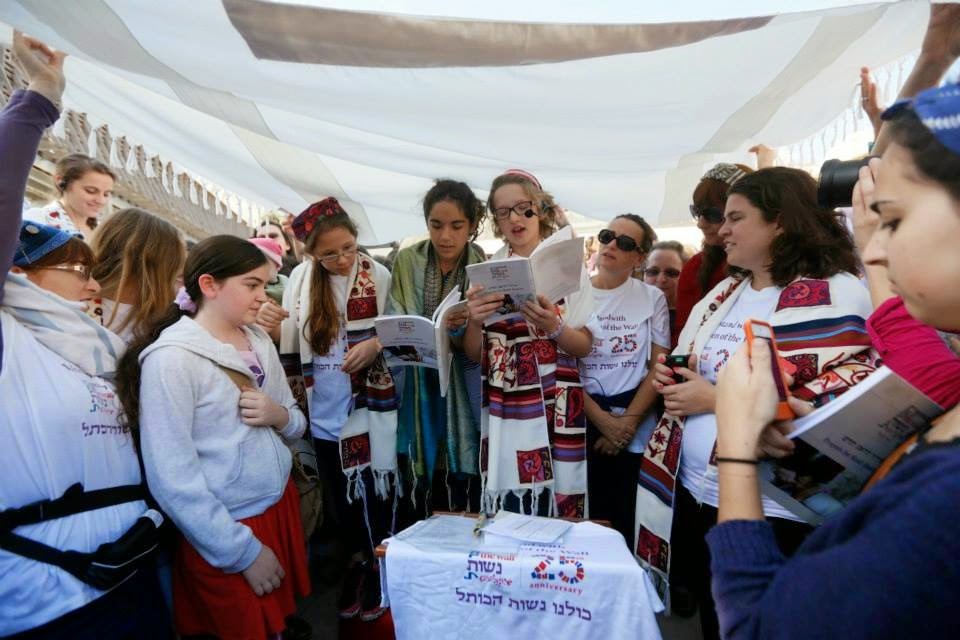
And I thought, surely the Shechina, the Divine Presence who always rests here, rejoices that I am here in the holy place with my tallit, surely the Shechina wants to hear the voices of all Jews raised in prayer in song , surely the Shechina understands that our prayers cannot cause harm to this holy place or to the feelings of the worshippers.
I thought about the 25 years that each month the Women of the Wall have come on Rosh Hodesh, in small groups and large, in rain or heat, in prayer and persistence, to lift their hearts and voices together in prayer out loud, wearing tallit and tefillin. I thought about the Israeli paratroopers who stood at the Wall in 1967 with tears streaming down their faces and of those same soldiers who stood again at the Wall with Anat Hoffman last February, and of the 10 women who were arrested after the paratroopers and the press left, “so as not to cause harm to this holy place or to the feelings of the worshippers.”
זֶה-הַיּוֹם, עָשָׂה יְהוָה; נָגִילָה וְנִשְׂמְחָה בוֹ
Zeh Hayom Asah Adonai Nagilah v'nis'mecha vo
This is the Day that God has made, let us rejoice and be glad in it. (Psalm 118:24)
This is the Day that God has made, let us rejoice and be glad in it. (Psalm 118:24)
And I rejoiced. With more than 800 Jewish women who gathered from all over Israel and across the world, and over 200 male supporters who stood behind the mechitza and the barrier, I rejoiced. I rejoiced with Orthodox and Reform and Conservative and Reconstructionist and Renewal and Just Jews, I rejoiced. I rejoiced with the young girls who were under a tallit chuppah to chant the blessings for the Rosh Hodesh Torah reading. I rejoiced with the Israeli policewomen who came not to harass us this time, not to tell us to shhh be quiet or to wrap our tallitot like scarves, but this time to ring our group with their bodies to protect us from harassment and from things thrown at us, from spitting and yelling and whistles.
And I thought, surely the Shechina, the Divine Presence who always rests here, rejoices that I am here in the holy place with my tallit, surely the Shechina wants to hear the voices of all Jews raised in prayer in song , surely the Shechina understands that our prayers cannot cause harm to this holy place or to the feelings of the worshippers.
Subscribe to:
Posts (Atom)

 Posts
Posts